

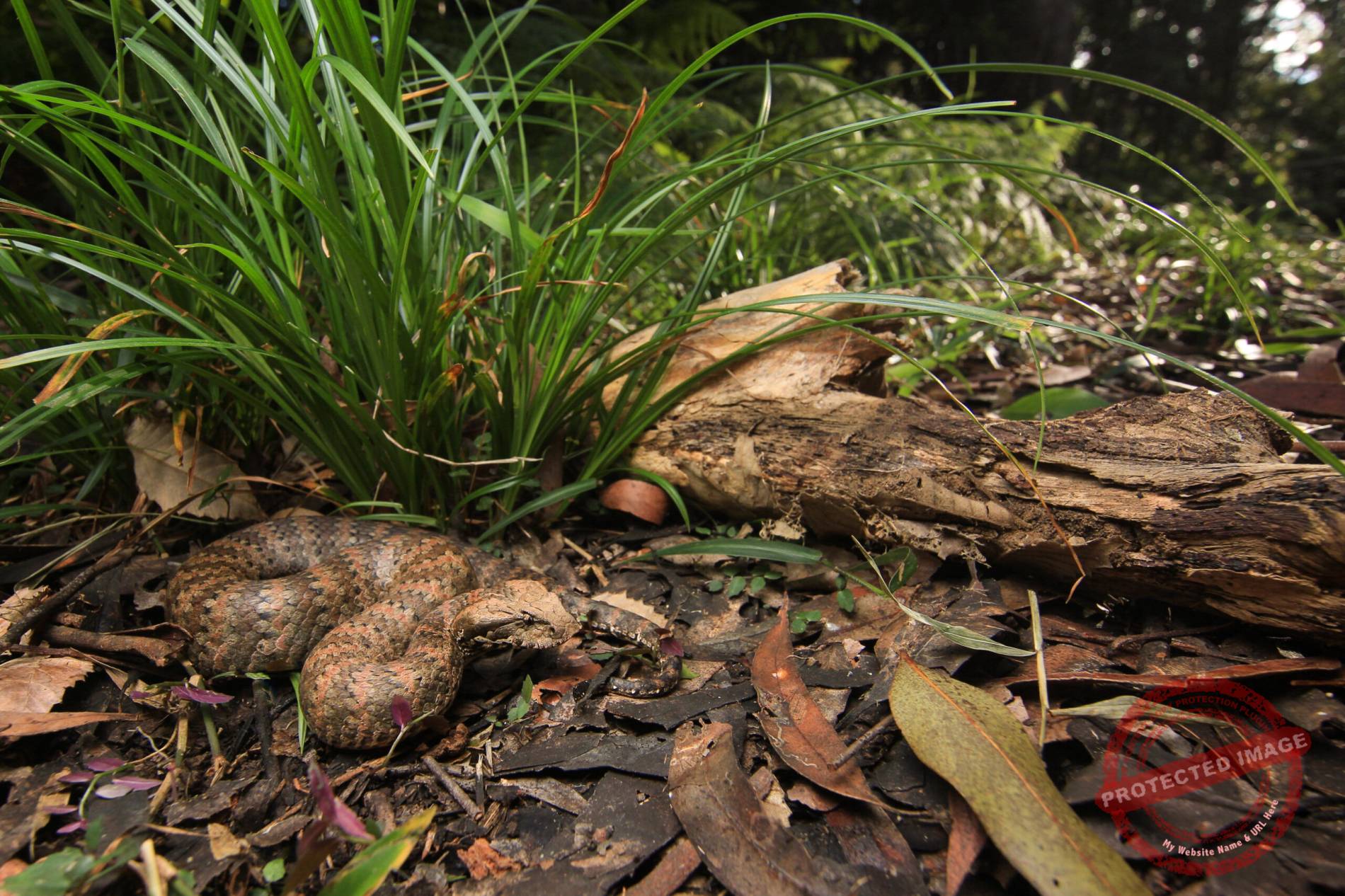
Beneath the dry leaves and red sands of eastern and southern Australia, the Common Death Adder (Acanthophis antarcticus) lies in wait like a coiled secret. With a deceptive stillness that belies its deadly efficiency, this ambush predator is one of the most iconic and misunderstood snakes in Australia. Its name conjures fear, yet its quiet role in the bush is far more complex and poetic than its reputation suggests. The Common Death Adder is not a chaser, but a patient hunter, relying on camouflage, lures and lightning reflexes to make its living in the understorey.
Identification
The Common Death Adder is a heavily built snake with a short, stout body and a broad, triangular head. It ranges in length from 60 to 100 cm, though some individuals may reach up to 110 cm. The body is often adorned with distinct crossbands of red, brown, grey, or black, depending on locality, which help it blend into leaf litter and gravelly soils. Unlike most Australian elapids, the death adder has a relatively short and tapering tail that ends in a unique soft, worm-like tip used as a lure. Its fangs are exceptionally long for an elapid, allowing it to deliver deep, rapid strikes.
Habitat and Distribution
Acanthophis antarcticus is distributed widely across eastern and southern Australia, from coastal New South Wales and Queensland into inland South Australia and parts of southern Western Australia. It inhabits a range of environments, including open woodlands, heathlands, forest edges and arid scrublands. The species favours areas with ample ground cover such as leaf litter, logs, rocks, or grasses, which it uses both for concealment and hunting. Its camouflage is so effective that it often goes unnoticed until it moves or strikes.
Ecological Role
The Common Death Adder plays an important role in regulating small mammal and reptile populations. It preys primarily on frogs, lizards and small mammals, often using caudal luring to attract prey by twitching the tip of its tail to mimic a worm or insect. This hunting technique sets it apart from most Australian snakes, which actively forage. In turn, death adders are preyed upon by birds of prey, large reptiles and introduced predators such as foxes and cats. Due to its ambush strategy and sensitivity to habitat disturbance, the death adder can serve as an ecological indicator of ground-level habitat health.
Behaviour and Reproduction
True to its name, the death adder relies on a passive ambush strategy, remaining motionless for hours or even days, concealed beneath leaves or debris. When prey draws near, it strikes with astonishing speed – often faster than the blink of an eye. Despite its deadly reputation, the species is generally non-aggressive and will usually not bite unless provoked or accidentally stepped on.
Breeding occurs in late spring and summer. Unlike many snakes, the Common Death Adder is viviparous, giving birth to live young. Litters can number between 10 and 30 neonates, each born fully formed and independent. The young are venomous from birth and capable of hunting shortly after parturition.
Conservation Status
The Common Death Adder is not currently listed as threatened under the Queensland Nature Conservation Act 1992 or other state conservation listings where it occurs, though it is considered locally uncommon in parts of its range. Its secretive nature makes population trends difficult to assess with certainty.
Threats
Despite its broad distribution, the Common Death Adder faces a number of threats. Habitat loss from agriculture, urban expansion and forestry significantly reduces suitable cover and prey availability. The spread of invasive cane toads (Rhinella marina) has also impacted populations, as death adders are highly susceptible to toad toxins. In addition, predation by introduced cats and foxes, as well as road mortality and persecution due to fear or misidentification, contribute to local declines. Climate change, particularly the intensification of droughts and fire regimes, may further impact ground-level microhabitats essential to this species.
Conservation Efforts
Conservation efforts for the Common Death Adder are largely indirect, relying on broader habitat protection and the management of invasive species. Protected areas that preserve natural understorey habitats provide refuge for populations. Public education campaigns promoting awareness of the death adder’s behaviour and ecological role have helped reduce unnecessary killings. Continued research into the species’ distribution, genetics and susceptibility to cane toads is ongoing, with hopes of identifying resilient populations and informing future conservation action.
Final Thoughts
The Common Death Adder is a reminder that nature’s most efficient predators are often those who wait quietly in the margins. With its cryptic colours, hypnotic tail lures and sudden strikes, it is a master of restraint and precision. To understand and protect this species is to appreciate the subtle artistry of ambush, the value of healthy ground cover and the intricate ties that bind predator and prey in Australia’s diverse ecosystems. Though it carries a deadly name, the death adder’s true story is one of balance, beauty and deep evolutionary heritage.
Fauna Resources specialises in the safe handling of a range of different fauna species, through safe, effective and ethical fauna solutions. By providing dedicated fauna services, through passionate fauna spotter catchers and fauna specialists, we can support the unique terrestrial ecosystems and rich biodiversity Australia has to offer.
For more information about our specialist fauna services contact Fauna Resources today.