

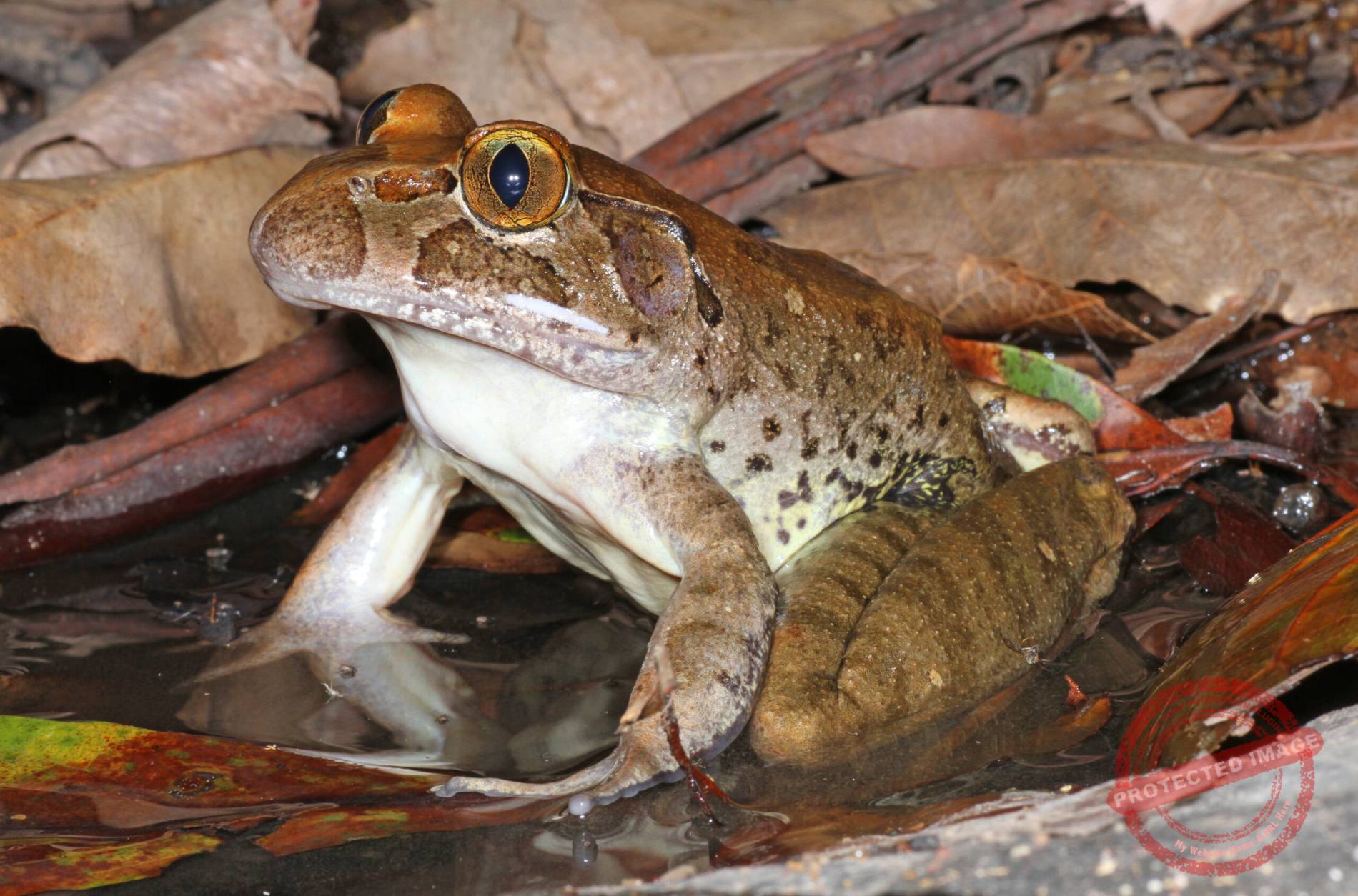
In the deep gullies of eastern Australia’s rainforests and wet sclerophyll forests, the booming call of a large, ground-dwelling frog signals the presence of one of the country’s most impressive amphibians. The Giant Barred Frog is a creature of swift-flowing streams, leaf-littered banks and shaded creek beds, where its strong legs and cryptic markings make it both a hunter and a master of camouflage. This species, once widespread, now serves as a sentinel of ecosystem health – a giant whose presence tells a story of ancient forests and fragile waterways.
Identification
The Giant Barred Frog is among Australia’s largest frog species, with females reaching over 115 millimetres in body length and males somewhat smaller. It is named for the prominent dark bars that cross its strong hind limbs – a pattern that, along with its marbled brown and olive body, blends perfectly into the forest floor. The ventral surface is creamy white and the head is broad with a pointed snout and large, golden eyes positioned high for a semi-subterranean, ambush lifestyle. The fingers are unwebbed while the toes are strongly webbed, well suited to gripping wet surfaces and propelling the frog through fast-moving water.
Habitat and Distribution
Endemic to eastern Australia, the Giant Barred Frog is found from southeast Queensland to northeast New South Wales, where it inhabits subtropical and warm temperate rainforest, wet sclerophyll forest and riparian zones in deeply incised catchments. It is highly dependent on intact vegetation cover and permanent or near-permanent streams, particularly those with shaded banks and low levels of disturbance. The species shelters under logs, rocks and leaf litter during the day, emerging at night to feed and call near water. Its reliance on healthy stream systems makes it particularly sensitive to environmental change.
Ecological Role
As a predator of insects, spiders and small vertebrates, the Giant Barred Frog plays a role in regulating invertebrate populations and maintaining ecological balance within rainforest and riparian systems. In turn, it is prey for snakes, birds and introduced predators such as foxes and cats. The tadpoles are among the largest of any Australian frog, reaching up to 80 millimetres in length and play an important part in nutrient cycling within aquatic systems. The presence or absence of these tadpoles can reflect the health of stream ecosystems, making the species a valuable bioindicator.
Behaviour and Reproduction
The species is mostly nocturnal and cryptic, often going unnoticed even in areas where it is locally common. Males call from the banks of streams, producing a deep, grating ‘ork’ from concealed positions during spring and summer months. Breeding occurs in flowing water, where eggs are laid in shallow stream edges or attached to submerged vegetation. Tadpoles take several months to develop, depending on water temperature and food availability, before metamorphosing into juvenile frogs that remain close to the stream during early development. The species relies on consistent streamflow and good water quality for successful reproduction.
Conservation Status
In Queensland, the Giant Barred Frog is listed as Vulnerable under the Nature Conservation Act 1992. Habitat loss, water quality decline and disease have contributed to significant contractions in the species’ historical range. The species is also listed as Vulnerable under the Commonwealth Environment Protection and Biodiversity Conservation Act 1999.
Threats
The most pressing threat to the Giant Barred Frog is the degradation of its stream and riparian habitats. Clearing of native vegetation, stream siltation and changes to flow regimes through water extraction and land use intensification have reduced suitable breeding sites. Invasive weeds such as lantana alter the understorey and affect stream shading. Chytrid fungus, a lethal amphibian pathogen, poses a significant disease risk, especially in cooler highland areas. Predation by introduced foxes and cats and road mortality near breeding sites, further endanger fragmented populations.
Conservation Efforts
Efforts to conserve the Giant Barred Frog include habitat restoration and the protection of riparian vegetation corridors, particularly in known breeding catchments. Monitoring programs have been established to track population trends and assess stream health. Research into disease dynamics and captive breeding potential is ongoing. Community involvement through landholder partnerships and waterway management schemes plays an essential role in preserving habitat quality and reducing disturbance near critical sites.
Final Thoughts
The Giant Barred Frog is a striking yet vulnerable resident of Australia’s eastern forests – a creature that reflects both the majesty and the sensitivity of its watery domain. Its survival is tightly bound to the health of rainforest streams and the quiet spaces beneath the ferns and stones. To protect this species is to protect the clean water, intact understorey and living corridors of the forest itself. In every low call that echoes from the creek and every camouflaged movement along a muddy bank, the Giant Barred Frog reminds us that some giants live not by towering above, but by staying close to the ground they depend upon.
Fauna Resources specialises in the safe handling of a range of different fauna species, through safe, effective and ethical fauna solutions. By providing dedicated fauna services, through passionate fauna spotter catchers and fauna specialists, we can support the unique terrestrial ecosystems and rich biodiversity Australia has to offer.
For more information about our specialist fauna services contact Fauna Resources today.