

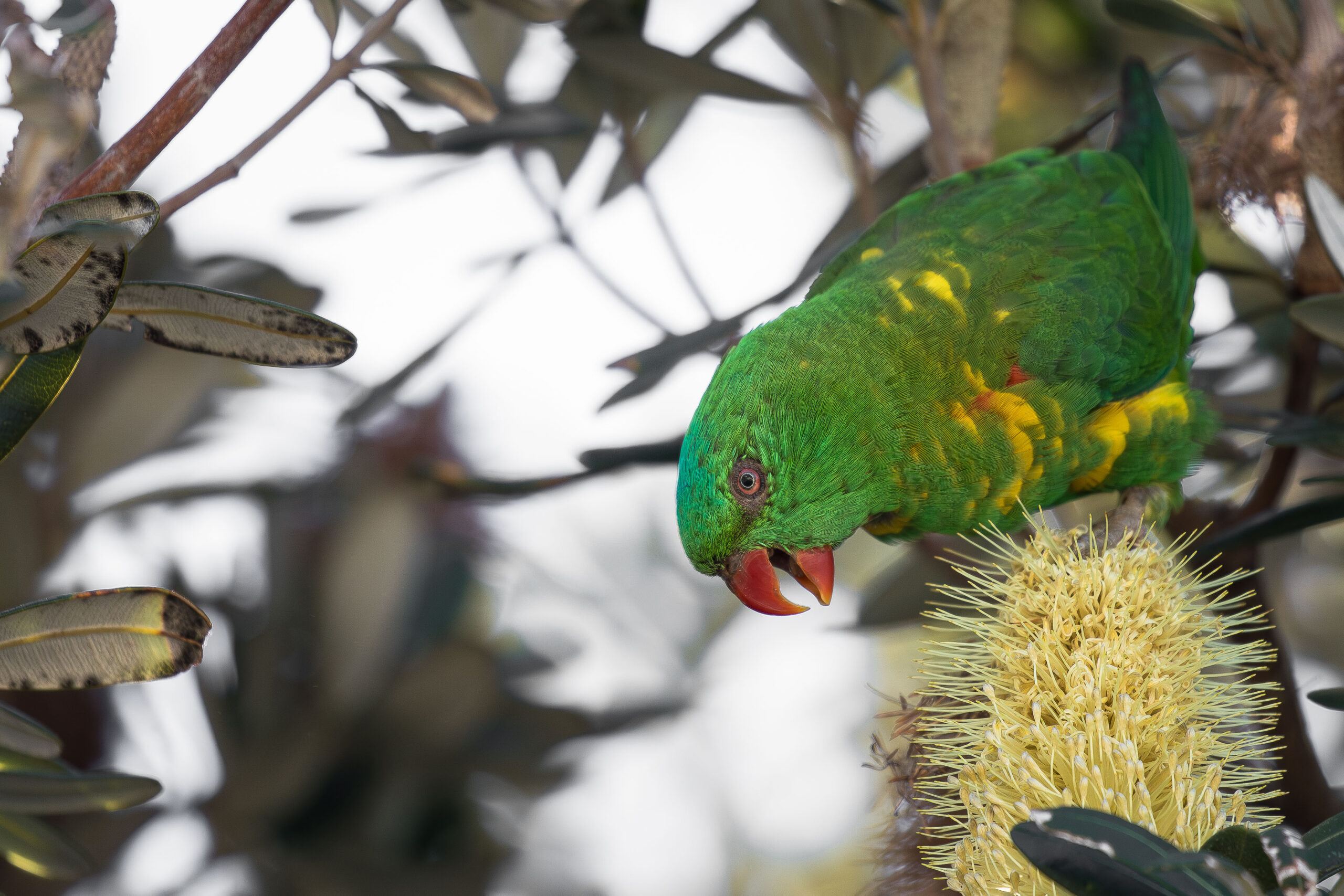

A vibrant streak of green flitting through flowering eucalypts, the Scaly-breasted Lorikeet (Trichoglossus chlorolepidotus) is a common yet captivating resident of eastern Australia. Often overshadowed by its rainbow-coloured relatives, this species brings a subtle elegance to the canopy with its lime-green plumage and golden-yellow scaling across the chest. Highly social and energetic, it plays a vital role in pollination and is often seen chattering in noisy flocks as it moves between feeding sites.
Identification
The Scaly-breasted Lorikeet is a small, compact parrot reaching approximately 23 cm in length. It is primarily bright green with conspicuous yellow markings on the breast and neck, giving it the “scaly” appearance for which it is named. The head is a uniform green, distinguishing it from the Rainbow Lorikeet and the bill is orange-red with a paler tip. The underwings and thighs are tinged with red-orange, visible during flight. Juveniles are duller with brownish beaks. Their brush-tipped tongue is highly specialised for feeding on nectar and pollen.
Habitat and Distribution
This species is found along the eastern seaboard of Australia, from northern Queensland through to north-eastern New South Wales. It prefers open forests, woodlands, coastal heathlands and urban gardens, particularly those dominated by flowering native trees such as Eucalyptus and Melaleuca. The Scaly-breasted Lorikeet adapts well to urban environments, frequenting parks and backyards where food sources are abundant. It is largely sedentary, though may exhibit local movements in response to flowering events.
Ecological Role
Trichoglossus chlorolepidotus is a key pollinator in many Australian ecosystems. Using its brush-tipped tongue, it collects nectar and pollen from flowering plants, inadvertently transferring pollen between flowers. Its feeding habits support the reproductive cycles of many native tree and shrub species. The lorikeet also consumes soft fruits and occasionally seeds, contributing to seed dispersal. In large numbers, it can influence flowering success and plant community dynamics in both natural and modified landscapes.
Behaviour and Reproduction
Highly gregarious, Scaly-breasted Lorikeets are often seen in pairs or flocks, sometimes mixing with Rainbow Lorikeets. They are fast, acrobatic fliers and display an impressive agility when feeding among branches. Breeding typically occurs from August to January, though may vary with local conditions. Pairs nest in tree hollows, often choosing eucalypts near water or feeding areas. The female lays 2-3 eggs and incubates them alone, while the male provides food. Both parents feed the chicks post-hatching, which fledge after around 6-8 weeks. Outside the breeding season, they form large, noisy roosts in trees, sometimes numbering in the hundreds.
Conservation Status
The Scaly-breasted Lorikeet is listed as Least Concern under the Queensland Nature Conservation Act 1992. It remains common and widespread throughout its eastern range, benefiting from the proliferation of flowering trees in suburban settings.
Threats
Although currently secure, potential threats include competition for nesting hollows with other bird species and feral honeybees, habitat loss through clearing of mature eucalypt woodlands and localised poisoning from garden pesticides. In urban areas, lorikeets may also suffer from a disease known as Lorikeet Paralysis Syndrome, which affects their mobility and can be fatal. Additionally, interbreeding with Rainbow Lorikeets in some regions raises concerns about genetic dilution.
Conservation Efforts
Conservation efforts for this species largely focus on habitat protection and the preservation of old-growth trees that provide nesting hollows. Public awareness campaigns in affected areas help reduce the risk of disease transmission and promote wildlife-friendly gardening practices. Community efforts to retain or plant native flowering trees also support their continued presence in developed areas.
Final Thoughts
The Scaly-breasted Lorikeet brings colour, life and ecological value to Australia’s eastern woodlands and gardens. Though often overlooked in favour of flashier species, its role as a pollinator and its adaptability to urban environments make it an important member of Australia’s avifauna. Protecting the green-dappled canopy and nesting hollows that this lorikeet depends on ensures not only the survival of Trichoglossus chlorolepidotus but the broader floral communities it sustains with each foraging flight.
Fauna Resources specialises in the safe handling of a range of different fauna species, through safe, effective and ethical fauna solutions. By providing dedicated fauna services, through passionate fauna spotter catchers and fauna specialists, we can support the unique terrestrial ecosystems and rich biodiversity Australia has to offer.
For more information about our specialist fauna services contact Fauna Resources today.