

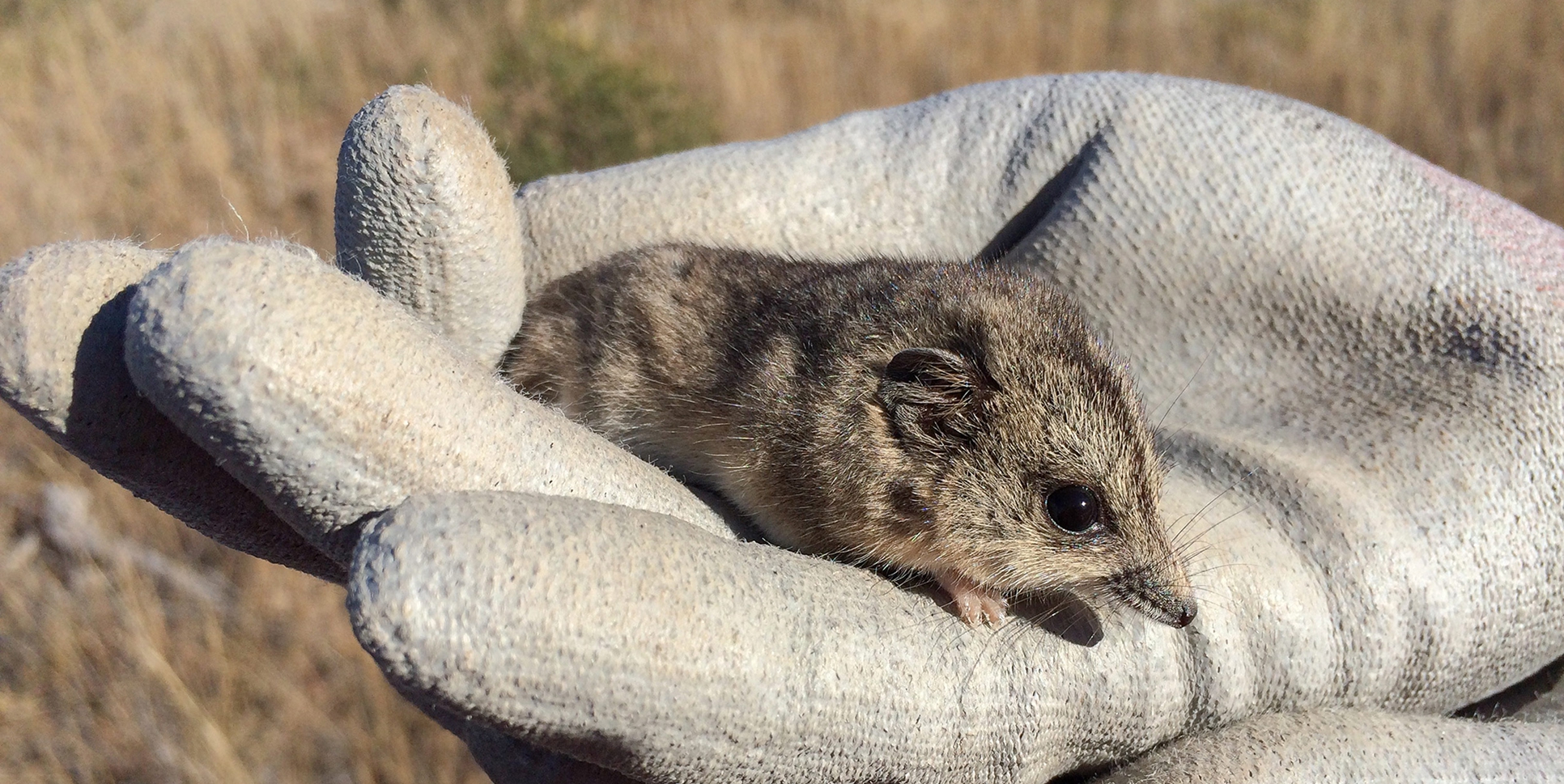
Among the dry heaths and open forests of eastern and southern Australia scurries a small but fierce hunter – the Slender-tailed Dunnart (Sminthopsis murina). A marsupial mouse in appearance, yet a predator by nature, this tiny creature represents the remarkable diversity of Australia’s dasyurid marsupials. Despite weighing no more than a few teaspoons of sugar, the Slender-tailed Dunnart is a bold insectivore, living fast-paced lives in landscapes often overlooked.
Identification
The Slender-tailed Dunnart is one of the smaller species of dunnart, with adults ranging from 70 to 105 mm in body length and a tail equal to or slightly longer than the head-body length. It weighs between 15 and 25 grams. Its tail is thin, tapering and covered in short fur – the feature that gives the species its name and helps distinguish it from other dunnarts with more thickened or swollen tails. The fur is soft and grey-brown dorsally, paler below, with a fine muzzle and large black eyes suited to nocturnal activity. Its small ears are rounded and prominent, enhancing its alert and lively appearance.
Habitat and Distribution
Sminthopsis murina is distributed across eastern and southern Australia, from Queensland through New South Wales, Victoria and South Australia, extending into Tasmania. It occupies a wide variety of habitats, including coastal heathlands, dry sclerophyll forests, open woodlands and grasslands. It shelters in leaf litter, grass tussocks, hollow logs and sometimes beneath rocks or in burrows. Despite its adaptability, it is strongly tied to areas with dense ground cover, which provide protection from predators and abundant invertebrate prey.
Ecological Role
As a small carnivorous marsupial, the Slender-tailed Dunnart plays a critical role in controlling insect and invertebrate populations. Its diet consists primarily of insects, spiders and other arthropods, but it may also take small vertebrates such as lizards or frogs when available. In turn, it is preyed upon by owls, snakes and carnivorous mammals such as quolls, as well as introduced predators like cats and foxes. As both predator and prey, it is an integral component of the food web in the ecosystems it inhabits.
Behaviour and Reproduction
The Slender-tailed Dunnart is nocturnal and highly active, spending nights foraging among ground litter and low vegetation. It has a fast metabolism and must consume large quantities of food relative to its size. To cope with environmental extremes, it is capable of entering torpor – a state of reduced body temperature and metabolic activity that conserves energy during cold weather or food scarcity.
Breeding occurs seasonally, with females giving birth to litters of up to 10 young, usually between August and February depending on latitude. The tiny, underdeveloped young crawl into the mother’s pouch, where they attach to teats for several weeks. Once they leave the pouch, they continue to shelter with the mother in a nest until weaned. Lifespans are typically short, with many individuals living no more than 1 to 2 years in the wild.
Conservation Status
The Slender-tailed Dunnart is listed as a species of Least Concern across its range. It is widespread and adaptable, occupying a variety of habitats. However, local populations may be vulnerable to declines in heavily modified landscapes.
Threats
Major threats include predation by introduced cats and foxes, loss of ground cover due to land clearing and grazing and changes in fire regimes that simplify habitat structure. Road mortality may occur in some areas and competition with invasive rodents may present additional pressures.
Conservation Efforts
Conservation measures include habitat protection in reserves and national parks, as well as feral predator control programs that benefit dunnart populations. Research into population distribution, genetic diversity and responses to fire helps guide management. Maintaining ground cover and habitat complexity in agricultural landscapes is also critical to their survival outside reserves.
Final Thoughts
The Slender-tailed Dunnart is a reminder that ecological importance is not measured in size. Small, swift and fierce, it is both hunter and hunted, thriving in the complex ground layers of Australia’s landscapes. Its adaptability speaks to the resilience of marsupials in a changing world, but its reliance on intact ground cover makes it a symbol of the need to conserve even the smallest habitats. Protecting Sminthopsis murina is to protect the intricate web of life that exists in the overlooked understorey.
Fauna Resources specialises in the safe handling of a range of different fauna species, through safe, effective and ethical fauna solutions. By providing dedicated fauna services, through passionate fauna spotter catchers and fauna specialists, we can support the unique terrestrial ecosystems and rich biodiversity Australia has to offer.
For more information about our specialist fauna services contact Fauna Resources today.