

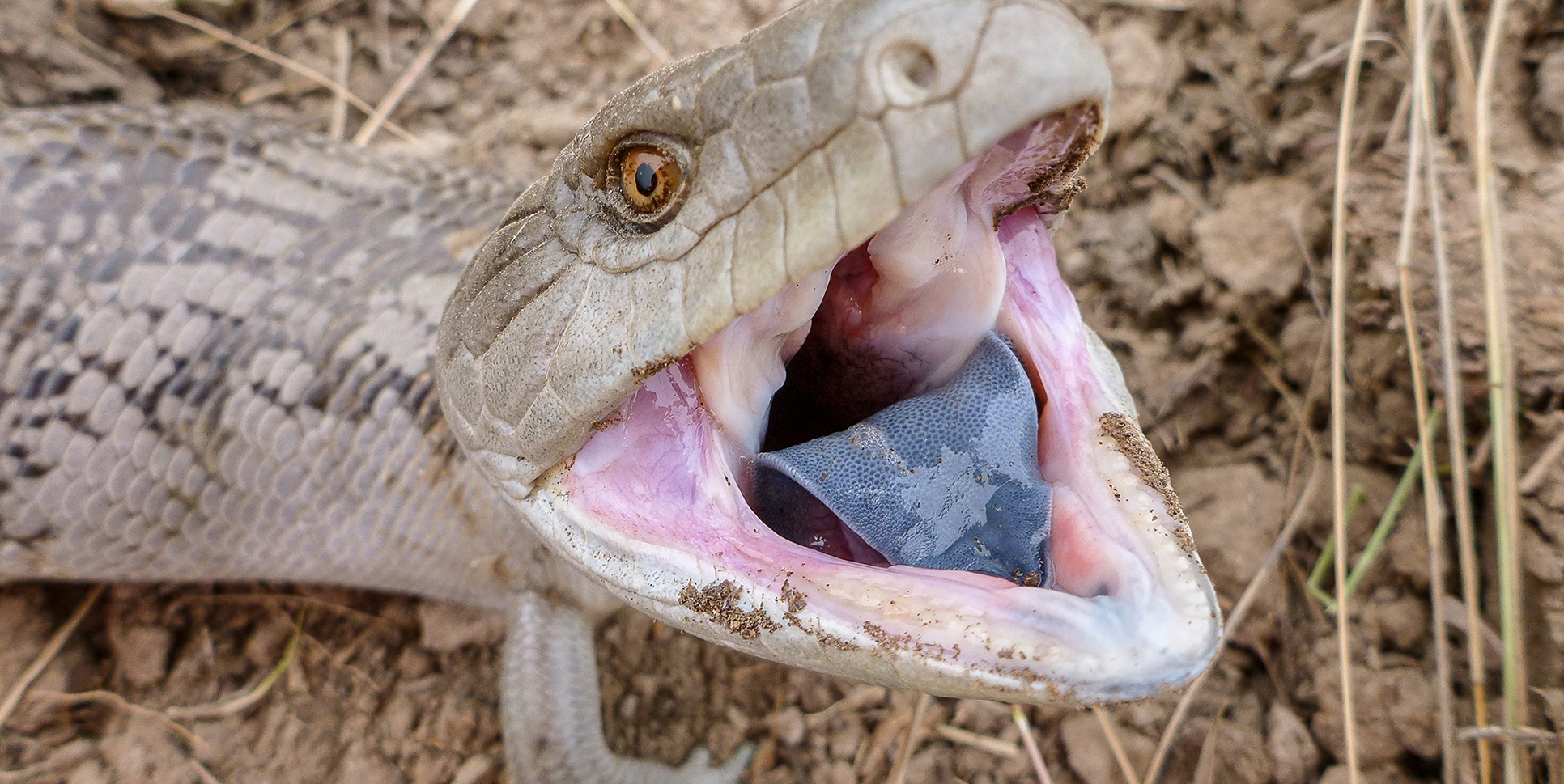
Australia’s dry woodlands and suburban backyards are home to one of the country’s most recognisable reptiles – the Blue-tongued Skink. With its stout body, smooth scales and startling indigo tongue, this unassuming lizard has earned affection across the continent. It’s a creature of contrasts: slow-moving yet resilient, gentle-natured yet equipped with a surprisingly effective defence strategy. Represented by several species across the country, blue-tongues are iconic in both wild and urban environments.
Identification
Blue-tongued Skinks are robust, low-slung lizards that can reach up to 60 cm in length. Their appearance is somewhat serpentine due to their short limbs and elongated body, but their distinctive traits quickly set them apart – most notably, the large, triangular head and the bright blue tongue that gives them their name. This vivid tongue is thrust out when the lizard feels threatened, a startling display meant to confuse or deter predators.
Their colouration varies by species and location, but most individuals sport a pattern of alternating bands in greys, browns, creams, or oranges. The scales are smooth and glossy, catching the sunlight as they bask in the open.
Species and Distribution
There are several species of blue-tongued skinks in Australia, including:
Tiliqua scincoides (Eastern Blue-tongue)
Tiliqua multifasciata (Centralian Blue-tongue)
Tiliqua rugosa (Shingleback or Bobtail)
Tiliqua adelaidensis (Pygmy Blue-tongue)
Tiliqua occipitalis (Western Blue-tongue)
Tiliqua nigrolutea (Blotched Blue-tongue)
These species occur across a range of habitats – from coastal heathlands and dry sclerophyll forests to arid inland scrublands. Some, like the Eastern Blue-tongue, have adapted remarkably well to urban environments and are frequently encountered in backyards and gardens, where they help control pests like snails and slugs.
Ecological Role
Blue-tongued Skinks are omnivores with a broad diet. They feed on insects, snails, fruits, flowers, fungi and carrion. Their generalist feeding habits make them important for controlling invertebrate populations and dispersing seeds. Their slow gait belies their adaptability – they are tenacious survivors that play a modest but meaningful role in maintaining ecological balance in both natural and disturbed landscapes.
Behaviour
Diurnal and largely solitary, blue-tongues are often seen basking in the morning sun or shuffling through leaf litter in search of food. When threatened, they flatten their body, hiss loudly and reveal their vibrant tongue in an impressive defensive posture. While capable of delivering a strong bite, they are not aggressive and usually prefer to retreat if given the chance.
They are viviparous, giving birth to live young rather than laying eggs – an adaptation well suited to unpredictable Australian climates. A female may produce 5 to 25 offspring, which are independent from birth and receive no parental care.
Conservation Status
The conservation status of Blue-tongued Skinks varies between species and states. Most widespread species such as Tiliqua scincoides and Tiliqua rugosa are listed as Least Concern in Queensland under the Nature Conservation Act 1992 and are not considered threatened in Western Australia under the Biodiversity Conservation Act 2016.
However, not all species share this security. The Pygmy Blue-tongue (Tiliqua adelaidensis) is classified as Endangered in South Australia and nationally under the EPBC Act. This rare species was once presumed extinct and survives only in isolated patches of native grassland, highlighting the vulnerability of specialist species within the group.
Threats
While some blue-tongue species thrive in human-dominated landscapes, others face mounting pressures. Habitat loss from agricultural clearing, urban expansion and road construction continues to reduce available shelter and foraging grounds. Predation by feral cats, dogs and foxes presents an ongoing threat, particularly to juveniles and smaller species. Vehicle strike is a common cause of mortality, especially in areas where lizards bask on roads or attempt to cross them during warmer months. There is also ongoing pressure from illegal collection for the pet trade, despite most Australian species being protected under state legislation. Misunderstandings by the public can sometimes lead to persecution, despite the species’ ecological benefits and docile nature.
Conservation Efforts
Blue-tongued Skinks are protected in all Australian states and territories, with strict regulations on the collection and keeping of wild individuals. Habitat preservation, especially in agricultural regions, remains vital to ensuring long-term survival, particularly for threatened species like the Pygmy Blue-tongue. Public education and citizen science initiatives have contributed to better understanding and appreciation of these reptiles, especially in suburban areas where people are encouraged to leave gardens skink-friendly.
Final Thoughts
The Blue-tongued Skink is a symbol of quiet persistence – a reptile equally at home in dusty outback tracks and neatly kept lawns. Its gentle nature, ecological value and iconic appearance have secured it a place in the hearts of many Australians. Ensuring their continued presence in our landscapes means valuing the small, the slow and the sun-loving among us – reminders that resilience often comes with scales and a blue tongue.
Fauna Resources specialises in the safe handling of a range of different fauna species, through safe, effective and ethical fauna solutions. By providing dedicated fauna services, through passionate fauna spotter catchers and fauna specialists, we can support the unique terrestrial ecosystems and rich biodiversity Australia has to offer.
For more information about our specialist fauna services contact Fauna Resources today.