

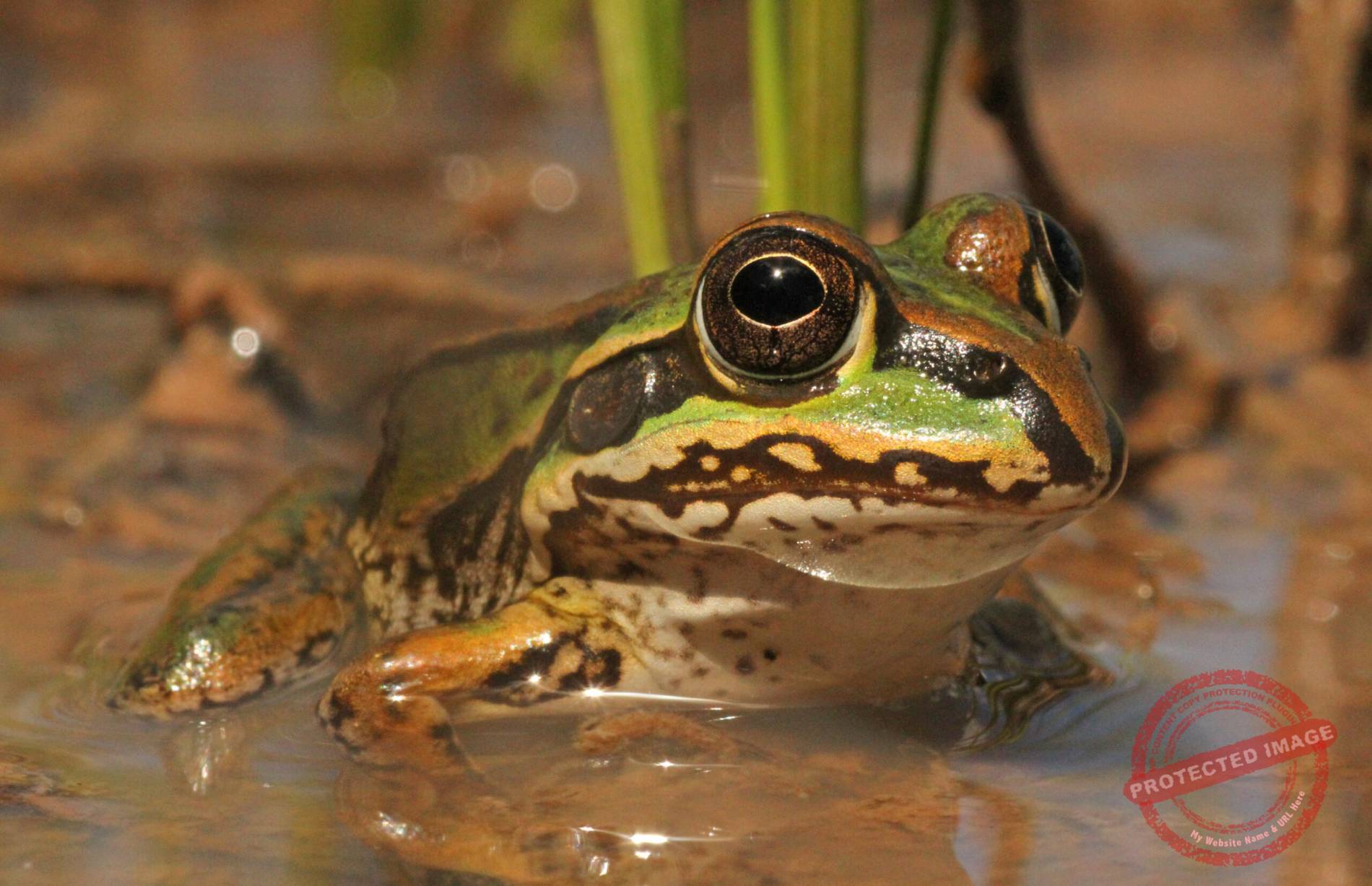
In the cracked claypans and ephemeral wetlands of inland eastern Australia, the Green-striped Frog lies buried beneath the surface, waiting for the rain. A true aestivating specialist, this frog survives months of aridity in dormancy, only to emerge in jubilant chorus when summer storms bring the land to life. Sometimes called the Striped Burrowing Frog, it is one of Australia’s remarkable rain-dependent amphibians – a creature finely tuned to the rhythms of drought and deluge.
Identification
The Green-striped Frog is a stocky and robust frog, reaching up to 7 centimetres in length. Its dorsal colour ranges from olive-green to dull brown, often patterned with lighter stripes and scattered pale spots. A distinctive greenish mid-dorsal stripe runs the length of the back, although this may be faint or absent in some individuals. The limbs are thick and well-muscled, with partially webbed toes suited for swimming in shallow water and digging into soft soils. The underbelly is pale, often whitish and the tympanum is prominent. When active, it is a powerful jumper, capable of leaping considerable distances across open ground.
Habitat and Distribution
The Green-striped Frog is found across much of Queensland and northern New South Wales, with a range extending into parts of the Northern Territory and eastern South Australia. It is primarily associated with clay-based soils in floodplains, black-soil country and open grasslands where water pools temporarily after heavy rain. These frogs spend the majority of the dry season buried underground, emerging only when intense rainfall triggers breeding activity. They are particularly abundant in areas with minimal tree cover, where ephemeral wetlands form quickly and offer fleeting windows for reproduction.
Ecological Role
As both predator and prey, the Green-striped Frog plays a central role in boom-and-bust inland ecosystems. It feeds voraciously on insects and other small invertebrates during the wet season, helping regulate pest populations. In turn, it is a key prey species for birds, snakes and mammals during mass emergence events. The tadpoles contribute to nutrient cycling within temporary wetlands, grazing on algae and organic debris and providing food for aquatic predators. The species’ emergence in response to rain also signals broader ecological shifts – its chorus marks the start of a brief window of productivity for the entire wetland community.
Behaviour and Reproduction
The Green-striped Frog is almost entirely inactive during dry periods, remaining underground in a state of aestivation. It forms a protective cocoon from shed skin to conserve moisture and reduce metabolic activity. When summer rains arrive, males begin calling from shallow, temporary pools with a loud, deep “waahk” or croaking grunt. Breeding is explosive and synchronised – large numbers gather to mate and females may lay thousands of eggs in foamy clumps or gelatinous strands on the water’s surface.
Tadpoles hatch within days and grow rapidly in the nutrient-rich, warm waters. They can reach over 5 centimetres in length and complete metamorphosis in as little as four to six weeks, depending on temperature and water persistence. Juveniles disperse quickly, feeding and growing before returning to dormancy underground as the wetlands dry out.
Conservation Status
The Green-striped Frog is currently listed as Least Concern in Queensland under the Nature Conservation Act 1992. Its widespread distribution and large population size provide some resilience, though its dependence on temporary water and suitable soils means it is vulnerable to environmental changes.
Threats
Primary threats to the Green-striped Frog include habitat loss through land clearing, soil compaction from overgrazing and the drainage or alteration of natural floodplains. In agricultural landscapes, pesticide use and changes to water quality may impact breeding success and tadpole development. Climate change is of particular concern for aestivating species – reduced rainfall frequency and intensity could lead to longer dry periods and fewer opportunities for reproduction. Local populations are also at risk from invasive predators and road mortality during breeding migrations.
Conservation Efforts
Conservation for this species focuses on maintaining healthy floodplain dynamics, protecting seasonal wetlands and ensuring that suitable soils remain undisturbed. The preservation of black-soil country and ephemeral claypan systems is essential for the species’ long-term survival. Environmental flow management and land stewardship initiatives can help support broader wetland biodiversity, benefiting the Green-striped Frog and associated species. Monitoring of calling males and tadpole surveys can offer insights into reproductive success and rainfall responsiveness.
Final Thoughts
The Green-striped Frog is a creature sculpted by extremes – silent in the dust for months, then suddenly alive in chorus under a summer sky. It is an amphibian of patience and timing, built not for constant presence but for perfect emergence. In every croak from a roadside puddle and every flash of green above cracked soil, it reminds us that some of the most extraordinary life stories are not those seen often, but those that arrive with the rain, live quickly and disappear as quietly as they came.
Fauna Resources specialises in the safe handling of a range of different fauna species, through safe, effective and ethical fauna solutions. By providing dedicated fauna services, through passionate fauna spotter catchers and fauna specialists, we can support the unique terrestrial ecosystems and rich biodiversity Australia has to offer.
For more information about our specialist fauna services contact Fauna Resources today.