

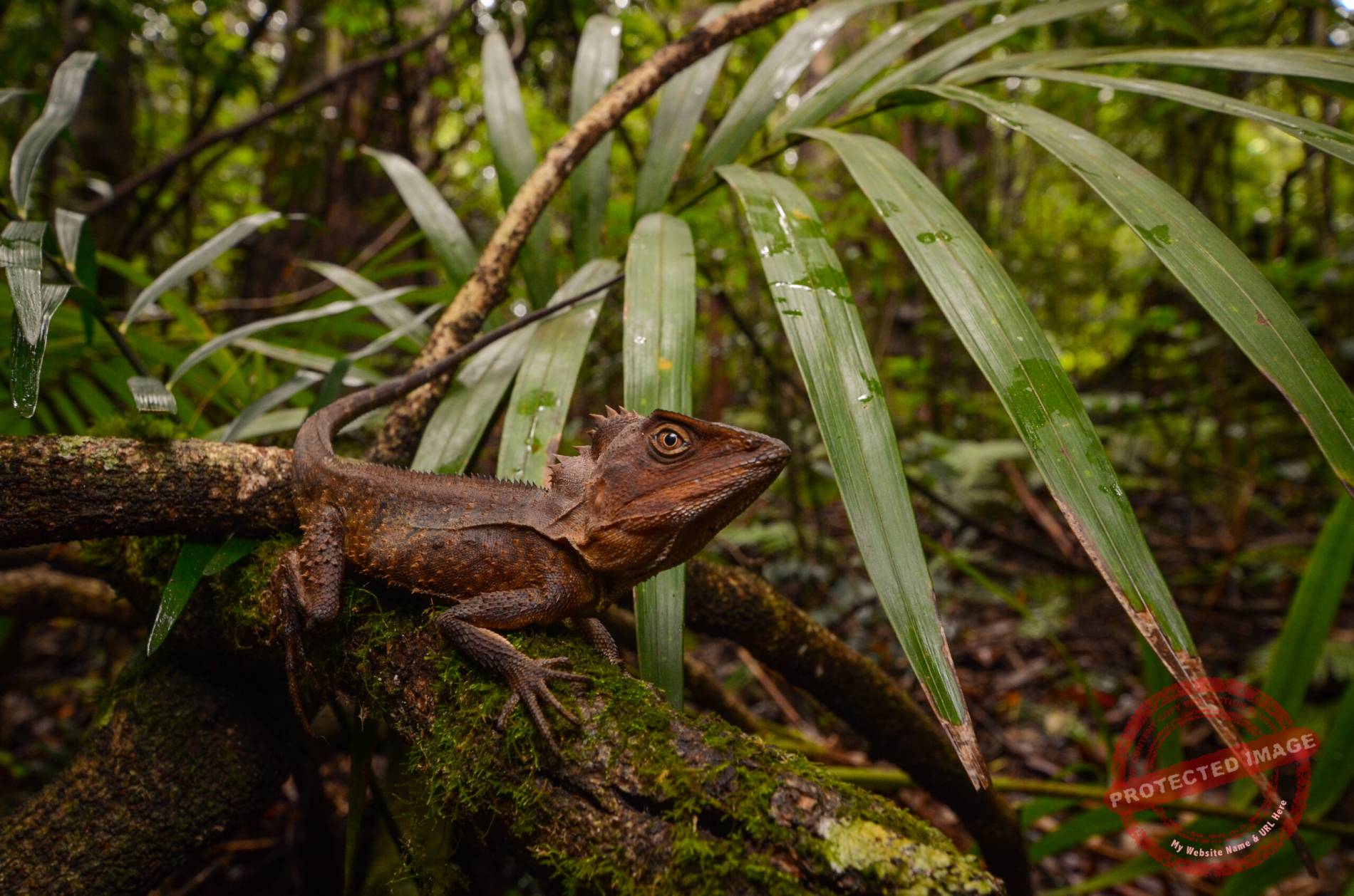
In the shaded gullies and subtropical rainforests of eastern Australia, where ferns unfurl and the canopy filters sunlight into dappled mosaics, the Southern Angle-headed Dragon (Lophosaurus spinipes) stands sentinel on tree trunks. With its prominent crest and statuesque stillness, this dragon lizard embodies the quiet majesty of forest life. More often seen clinging motionless to bark than scurrying across the ground, it is a creature that reflects the patience and intricacy of its arboreal world.
Identification
The Southern Angle-headed Dragon is one of Australia’s largest agamids, reaching 35 to 45 cm in total length, with a long, tapering tail that makes up much of its size. Its most striking feature is the high casque or “angle” at the back of the head, paired with a crest of small spines running down the neck and back. Colouration is typically grey-green to olive brown, patterned with mottling or faint bands that provide excellent camouflage against bark and foliage. The body is laterally compressed and the limbs are strong with long digits tipped in sharp claws for climbing. Unlike many dragons, it does not rely heavily on rapid movement but instead uses stillness and camouflage as its primary defence.
Habitat and Distribution
Lophosaurus spinipes is found along the east coast of Australia, from southeastern Queensland through much of eastern New South Wales, with its range extending into parts of Victoria. It inhabits subtropical and warm temperate rainforests, wet sclerophyll forests and densely vegetated gullies. The species is strongly arboreal, usually seen clinging to the trunks of large trees or resting in shaded understories close to streams and creeks. Its reliance on intact, moist forest habitats makes it sensitive to fragmentation and clearing.
Ecological Role
As an insectivore, the Southern Angle-headed Dragon preys primarily on invertebrates such as beetles, crickets, moths and spiders, but it may also consume small vertebrates including frogs and other lizards. In doing so, it helps regulate insect populations and contributes to the balance of forest ecosystems. It also serves as prey for predatory birds, snakes and larger reptiles. By occupying a niche as a slow-moving arboreal predator, it plays a distinct role in rainforest food webs.
Behaviour and Reproduction
Diurnal and predominantly sedentary, L. spinipes relies heavily on camouflage, often remaining motionless for long periods to avoid detection. When disturbed, it may move higher up a tree or freeze, blending with bark patterns. Unlike many other dragons, it rarely basks in open sunlight, instead regulating its body temperature in shaded microhabitats.
Breeding occurs in spring and summer. Males defend territories and may display by bobbing their heads or posturing to rivals. Females descend to the forest floor to lay clutches of 6 to 12 eggs in shallow nests dug into soil or leaf litter. The eggs incubate for several months before hatchlings emerge, climbing immediately into surrounding vegetation to begin their arboreal lives.
Conservation Status
The Southern Angle-headed Dragon is currently listed as a species of Least Concern in Queensland and New South Wales, though it depends on intact forest habitats and may be locally affected by land clearing and habitat degradation. Its restricted ecological niche makes it more vulnerable than widespread generalist lizards.
Threats
Key threats include habitat fragmentation due to logging, agriculture and urban development, which reduce the extent of continuous rainforest and limit movement between populations. Predation by feral cats and foxes poses an additional risk, especially to juveniles on the forest floor. Changes to fire regimes and climate-driven shifts in rainfall patterns may also affect the moist, shaded habitats the species requires.
Conservation Efforts
Much of the range of L. spinipes lies within national parks and reserves, including Gondwana Rainforests World Heritage areas, where habitat protection supports healthy populations. Conservation actions focus on maintaining habitat connectivity, preserving riparian corridors and managing invasive predators. Ongoing surveys and ecological studies improve understanding of population dynamics and resilience.
Final Thoughts
The Southern Angle-headed Dragon is a creature of stillness and shadow, perfectly adapted to the vertical world of trunks and leaves. It is a reptile that embodies patience rather than speed, blending into the living architecture of rainforest trees. Protecting Lophosaurus spinipes means protecting the forests themselves – complex, shaded worlds where dragons stand watch as silent custodians of ancient ecosystems.
Fauna Resources specialises in the safe handling of a range of different fauna species, through safe, effective and ethical fauna solutions. By providing dedicated fauna services, through passionate fauna spotter catchers and fauna specialists, we can support the unique terrestrial ecosystems and rich biodiversity Australia has to offer.
For more information about our specialist fauna services contact Fauna Resources today.