

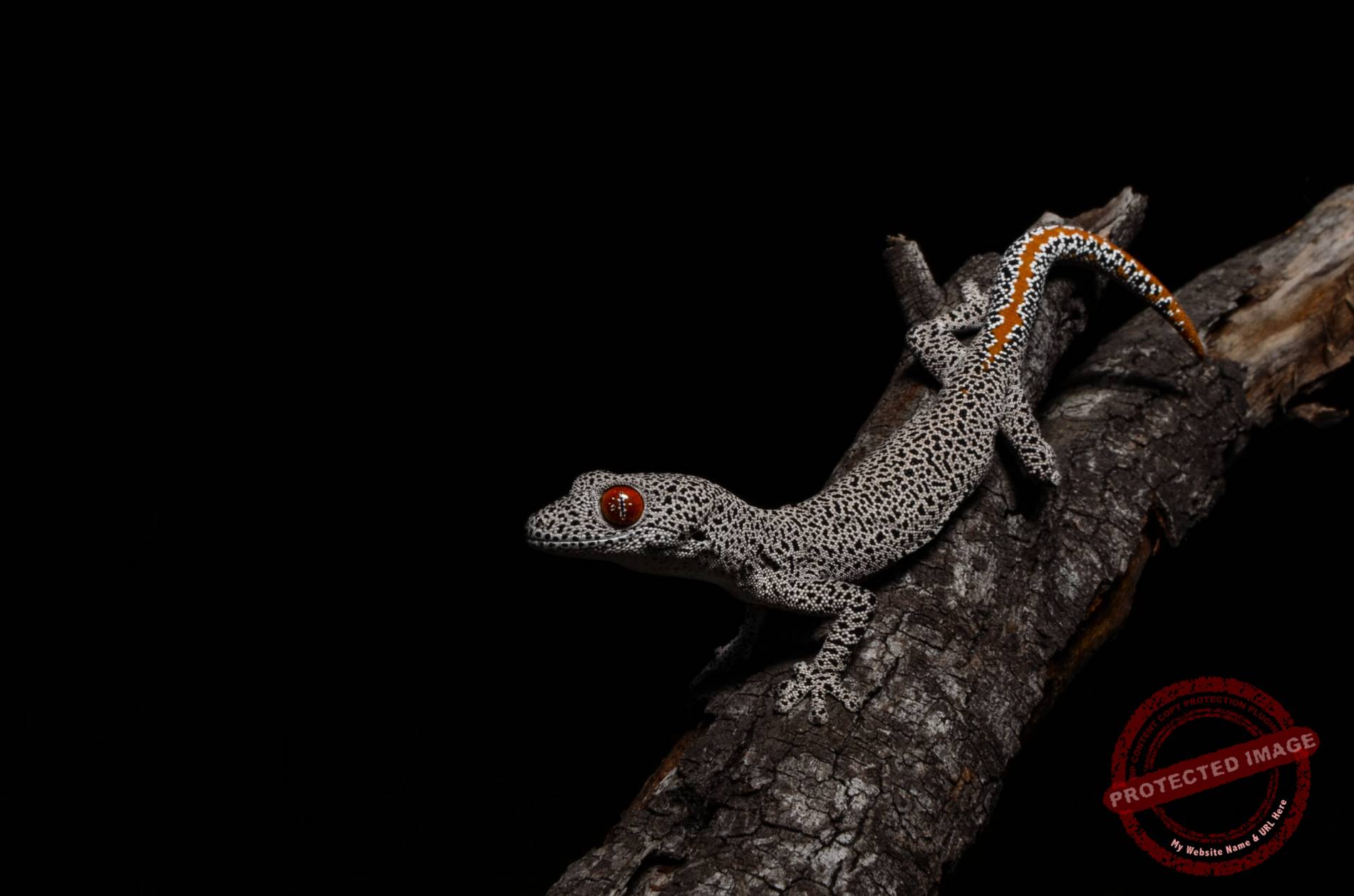
When night falls over the dry forests and woodlands of Queensland, the Golden-tailed Gecko (Strophurus taenicauda) emerges – a small yet dazzling lizard whose name comes from its striking, glittering tail. This nocturnal gecko is one of Australia’s most charismatic reptiles, known not only for its beauty but also for its fascinating defensive behaviours. Elusive and tied to specialised habitats, the Golden-tailed Gecko symbolises the hidden wonders of the Australian night.
Identification
The Golden-tailed Gecko is a medium-sized gecko, reaching around 10 to 12 cm in snout-to-vent length, with a long, slender tail. Its most distinctive feature is the golden-yellow tail, often flecked with darker spots or banding, which contrasts sharply with the mottled grey or brown body. The dorsal surface is patterned in irregular blotches that help it blend into bark and branches. Like other Strophurus geckos, it has large eyes with vertical pupils adapted for nocturnal life. One of its most remarkable traits is the ability to squirt a sticky, odorous fluid from glands at the base of its tail when threatened – a unique defence mechanism among geckos.
Habitat and Distribution
Endemic to Queensland, Strophurus taenicauda occurs in dry open forests, woodlands and brigalow (Acacia harpophylla) scrub, as well as eucalypt forests in the eastern and central regions of the state. It is strongly arboreal, often found clinging to tree trunks, branches, or under bark during the day. At night it becomes active, hunting insects among foliage and bark crevices. Its distribution is patchy and strongly linked to the availability of intact woodland habitats, many of which have been heavily cleared.
Ecological Role
As a nocturnal insectivore, the Golden-tailed Gecko plays an important role in controlling populations of moths, beetles and other invertebrates. In turn, it serves as prey for owls, snakes and predatory mammals. Its sticky defensive secretions may deter some predators, giving it a survival advantage in habitats where arboreal predators are common. By inhabiting woodland ecosystems, it contributes to the balance of both predator and prey dynamics in the arboreal layers.
Behaviour and Reproduction
The Golden-tailed Gecko is largely solitary, emerging after dusk to forage on tree trunks and foliage. During the day, it shelters beneath bark or in crevices, relying on camouflage to remain hidden. When threatened, it may raise and wave its brightly coloured tail as a distraction or discharge its defensive secretions.
Reproduction occurs in the warmer months. Like many geckos, females lay small clutches of two eggs in secure crevices or under bark. These eggs hatch after several weeks of incubation, with hatchlings resembling miniature adults, already equipped with their defensive capabilities.
Conservation Status
The Golden-tailed Gecko is listed as Near Threatened under the Queensland Nature Conservation Act 1992. Its populations have declined due to extensive loss of brigalow and eucalypt woodland habitats, which are critical for its survival.
Threats
The primary threat to Strophurus taenicauda is habitat destruction and fragmentation caused by broadscale clearing for agriculture, grazing and development. Removal of brigalow forests in particular has reduced much of its original range. Introduced predators such as cats and foxes also pose risks, as do altered fire regimes that reduce shelter and food availability. Because of its arboreal habits, the species is particularly vulnerable when large old trees and logs are removed.
Conservation Efforts
Conservation of the Golden-tailed Gecko centres on protecting and restoring brigalow and eucalypt woodland ecosystems. Many remnant habitats are now recognised as endangered ecological communities and are afforded protection under state and federal legislation. Ongoing surveys help monitor populations, while public education programs promote awareness of the species’ ecological role. Managing fire regimes and controlling invasive predators are also essential to its persistence.
Final Thoughts
The Golden-tailed Gecko is a jewel of Queensland’s woodlands – a reptile whose shimmering tail and unusual defences mark it as one of the most fascinating geckos in the world. Its survival depends on the preservation of the forests it calls home. Protecting Strophurus taenicauda is not just about saving a single lizard, but about ensuring the persistence of entire woodland ecosystems, where nocturnal life thrives unseen until nightfall.
Fauna Resources specialises in the safe handling of a range of different fauna species, through safe, effective and ethical fauna solutions. By providing dedicated fauna services, through passionate fauna spotter catchers and fauna specialists, we can support the unique terrestrial ecosystems and rich biodiversity Australia has to offer.
For more information about our specialist fauna services contact Fauna Resources today.