

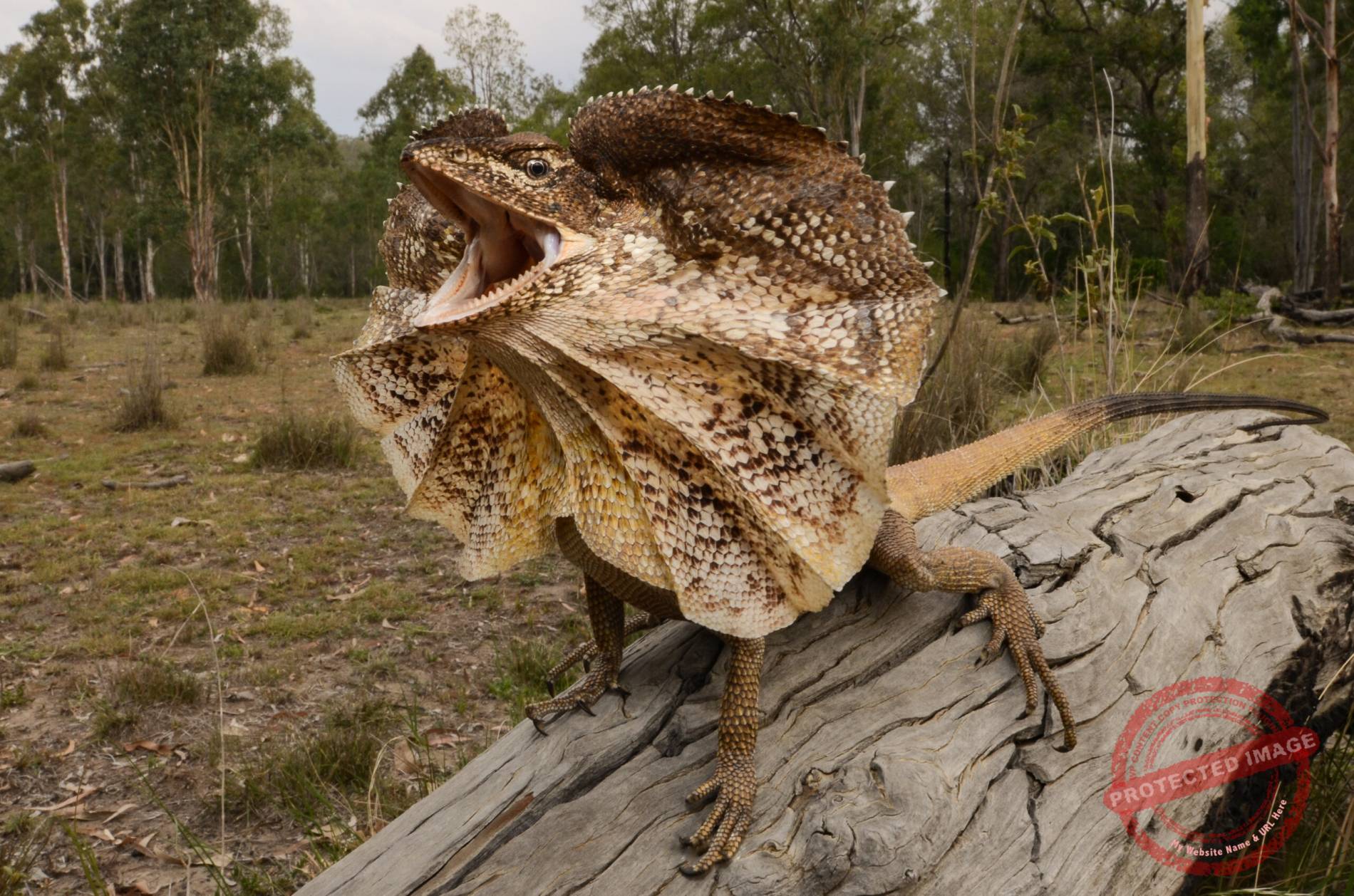
In the sunlit savannas and open woodlands of northern Australia, a sudden rustle in the dry grass is followed by one of the continent’s most iconic sights – a large lizard rising on hind legs, frill extended in a spectacular crown of colour, mouth agape in theatrical display. This is the Frill-necked or Frilled Lizard, a creature as bold in appearance as it is in behaviour. With its striking frill, upright stance and dramatic defence, it has become one of the most recognisable reptiles in Australia’s tropical north and a lasting symbol of outback wildlife.
Identification
The Frilled Lizard is a large, arboreal dragon that can reach up to 90 centimetres in total length, though much of that is tail. Its body is slender but muscular, covered in rough, keeled scales that range in colour from brown to grey, often tinged with orange or yellow. What sets this lizard apart is the large frill of skin around its neck, supported by elongated cartilaginous spines. When threatened or excited, it raises this frill to reveal bright patches of orange, red, or yellow on the inner surface. The display is accompanied by a wide gape, loud hissing and upright posture, designed to startle predators and assert dominance. When the moment passes, the frill folds back against the neck, almost invisible.
Habitat and Distribution
Frilled Lizards are found across northern Australia, from the Kimberley region in Western Australia through the Top End of the Northern Territory and into northern Queensland. Their range extends into southern New Guinea, where the species also occurs naturally. They inhabit tropical savannas, open forests, dry woodlands and even the fringes of agricultural land, as long as trees are present. These lizards are strongly arboreal, spending much of their time perched vertically on tree trunks, using the elevation to survey for food and threats. During the wet season, when food is abundant, they become more active and visible.
Ecological Role
As insectivores, Frilled Lizards play a valuable role in controlling insect populations, particularly large arthropods such as grasshoppers, beetles and ants. They also consume smaller reptiles, spiders and occasionally flowers or fruit. They are preyed upon by raptors, snakes and feral cats, especially when on the ground. Their bold defensive display helps to deter would-be predators and their ability to flee bipedally – sprinting upright on powerful hind limbs – adds another layer of surprise. In the ecosystem, they are both hunter and hunted and their presence reflects the health and complexity of the environments they occupy.
Behaviour and Reproduction
Frilled Lizards are most active during the warmer months, particularly during the wet season when food is plentiful. They are diurnal and spend much of the day basking or hunting. When disturbed, they retreat up trees or perform their frill display, followed by a sudden burst of speed on hind legs to escape. This running behaviour is unique among Australian dragons and adds to their reputation as charismatic and unusual reptiles.
Breeding occurs during the wet season. Males establish territories and display to females using head-bobbing, body posturing and frill extension. After mating, females lay a clutch of up to 20 eggs in a shallow burrow. The eggs incubate in the warm soil for several months, with hatchlings emerging fully independent. Young lizards resemble miniature adults and begin hunting immediately after hatching.
Conservation Status
The Frilled Lizard is listed as Least Concern under the Queensland Nature Conservation Act 1992 and is not considered threatened in any other part of its Australian range. It remains relatively common in suitable habitat and its widespread distribution across the tropical north contributes to its secure status. While local declines have been observed in some areas, particularly those with intensive land use or feral predator pressure, overall population trends remain stable.
Threats
Despite its secure conservation status, the Frilled Lizard faces a number of environmental pressures. Habitat loss through land clearing and grazing reduces the availability of trees and ground cover, impacting both shelter and prey abundance. Feral cats and foxes pose a significant threat, especially to juvenile lizards. Road mortality is a concern in areas where lizards bask or forage near roads. In some parts of its range, changes in fire regimes have altered habitat structure, potentially affecting food sources and nesting success. Additionally, while not a widespread issue, illegal collection for the pet trade has historically impacted populations, though captive breeding now supplies most demand.
Conservation Efforts
The species benefits from protection under state wildlife legislation and occurs in a number of national parks and Indigenous Protected Areas across its range. Management efforts that preserve native vegetation, control feral predators and maintain natural fire cycles are key to supporting healthy populations. Community education programs that promote awareness and appreciation of native reptiles have also helped reduce unnecessary persecution, especially in rural and regional areas.
Final Thoughts
The Frilled Lizard is a creature of flair and function – an animal that uses drama as a tool for survival, backed by genuine speed and agility. It is a reptile that commands attention, not just for its appearance but for the ancient rhythms it represents – sun, rain, movement and defence. Protecting this species means more than saving a charismatic animal. It means safeguarding the trees it climbs, the insects it feeds on and the wild, open spaces it needs to thrive. In every flare of the frill and burst of bipedal sprinting, we are reminded of how spectacularly strange and wonderfully adapted life can be in the Australian bush.
Fauna Resources specialises in the safe handling of a range of different fauna species, through safe, effective and ethical fauna solutions. By providing dedicated fauna services, through passionate fauna spotter catchers and fauna specialists, we can support the unique terrestrial ecosystems and rich biodiversity Australia has to offer.
For more information about our specialist fauna services contact Fauna Resources today.