

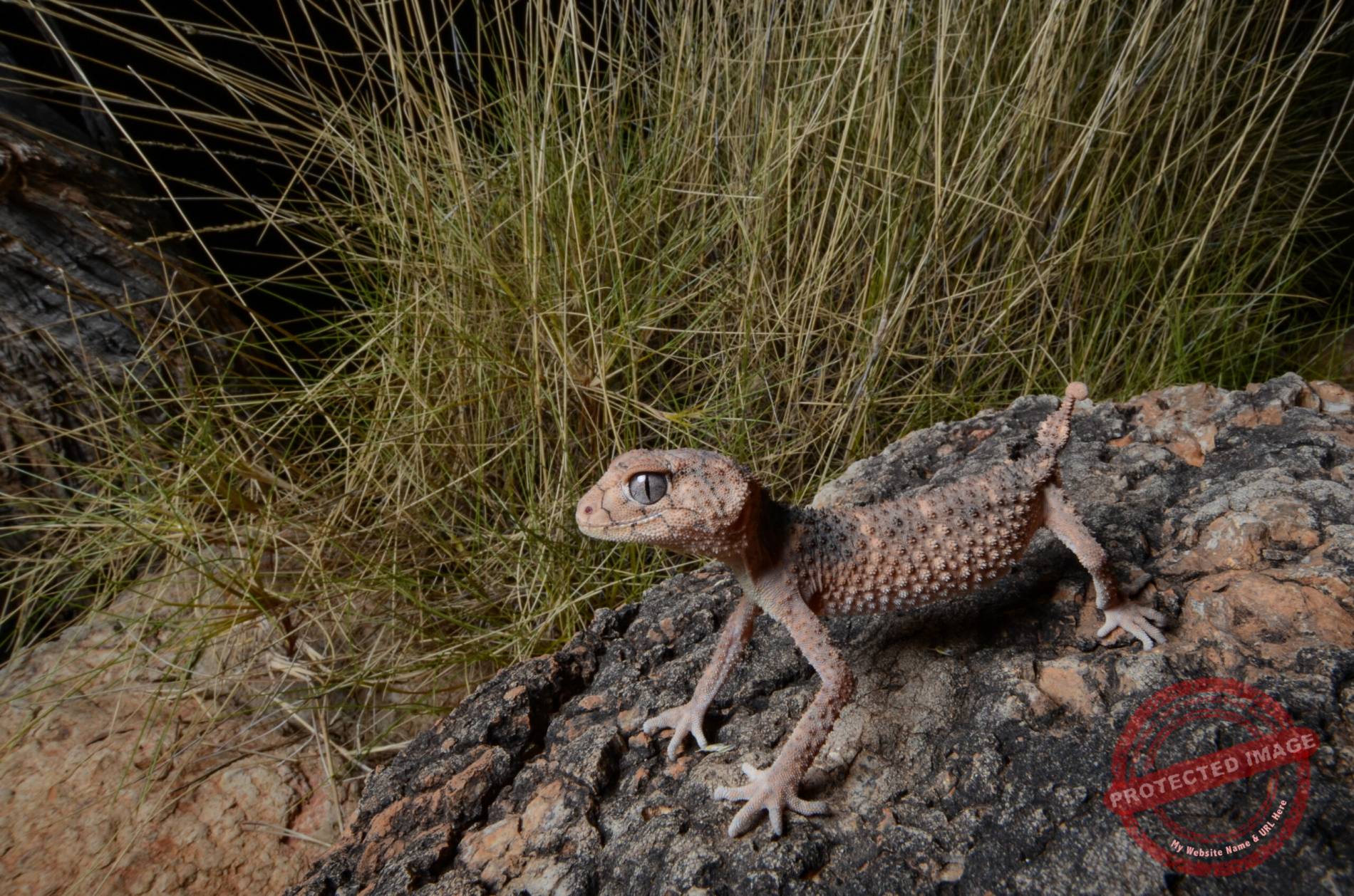
In the rugged mesas and breakaway country of western Queensland’s arid interior, where red earth meets horizon and rocky screes fringe the skies, lives a gecko of remarkable subtlety. The Eromanga Basin Knob-tailed Gecko (Nephrurus eromanga) is a recent addition to Australia’s rich reptile fauna – a spiny, ground-dwelling lizard that combines ancient lineage with modern cryptic adaptation. It is named for the Eromanga Basin, the vast sedimentary basin that frames the landscapes where it lives and its discovery reminds us that even in well-studied lands, new stories of biodiversity still wait to be found.
Identification
Nephrurus eromanga is a member of the spiny knob-tail gecko complex, distinguished by a combination of morphological and colour-pattern traits. Males attain a snout-to-vent length (SVL) of about 105 mm and females about 114 mm. Its general dorsal colouring is fawn to mid-brown or reddish brown, often with a contrasting dark saddle on the nape extending rearward past the forelimbs. Pale crossbands or blotches may be present, though the digits lack strong banding or mottling, helping distinguish it from related species like N. asper or N. sheai. The spines (tubercules) on the rump and thighs are moderately developed, not as extreme as in some relatives and the basal scales surrounding each tubercle are uniform and less than half the height of the central scale. One striking trait of the genus Nephrurus, including N. eromanga, is the inability to autotomise (shed) the tail – once lost, the tail is not regenerated.
Habitat and Distribution
This species is endemic to central western Queensland, in a region spanning from Windorah in the south to Winton in the east and Dajarra in the northwest. It is strongly associated with rocky breakaways and mesa country, typically living among scree, stony outcrops and boulders. Its occurrence overlaps with the geological bounds of the Eromanga Basin, whose semi-arid soils and structural features influence local microhabitats. Although much of its range lies within grazing lands, N. eromanga is known to persist in protected areas such as Diamantina National Park.
Ecological Role
As a ground-dwelling insectivore, N. eromanga likely predates on arthropods such as beetles, spiders and termites. Its cryptic form and slow, cautious foraging method suit its rocky habitat, where movement is risk-laden. By predating invertebrates, it contributes to ecological balance in a landscape where food webs are thin. Meanwhile, as a small reptile, it serves as prey for larger reptiles, birds of prey and other desert predators – part of the subtle chain of survival in arid lands.
Behaviour and Reproduction
Primarily nocturnal, N. eromanga emerges after dusk to forage among rocks and scree slopes. During daylight hours, it seeks refuge beneath stones or in crevices. It is not known to descend far from its rocky substrate, showing strong site fidelity to rugged terrain. Reproductively, this species is oviparous (egg-laying). Based on its close relatives, its clutch size is probably small (often two eggs), laid in sheltered positions within the rocky substrate or soil. There is limited published information yet on its breeding season, hatchling behaviour or longevity, given its recent formal description.
Conservation Status
Given its recent description in 2022 and relatively broad, albeit patchy distribution, Nephrurus eromanga does not currently have a threatened status under Queensland law. In the formal description, the authors suggest an IUCN status of Least Concern, citing that the species occupies a fairly large range and is known from protected areas. However, because much is unknown about its ecology, population trends and sensitivity to threats, it should be considered a species of conservation interest.
Threats
Key threats to N. eromanga include habitat alteration from grazing, land clearing and the removal of rocks and boulders for mining or construction – all of which degrade its specialised microhabitat. Climate change – particularly increases in maximum temperatures and the frequency of heat extremes – may strain populations in this already harsh environment. While it can persist in grazed lands, cumulative impacts from trampling, pasture modification and vegetation removal may erode local populations. Additionally, invasive predators such as feral cats and foxes likely pose predation pressure, especially on juveniles.
Conservation Efforts
Conservation of N. eromanga relies on protecting rocky outcrops and mesa habitats within its range. Ensuring that mining or grazing operations avoid or minimally disturb key scree and boulder areas is important. Its presence in Diamantina National Park is encouraging, but mapping of additional populations and habitat connectivity is still needed. Continued surveys, ecological research and monitoring will help track population health and identify vulnerable populations. Public awareness is also essential – many knob-tail geckos are misunderstood or inadvertently harmed.
Final Thoughts
The Eromanga Basin Knob-tailed Gecko is a testament to the hidden diversity of Australia’s arid zones – a spiny, rock-dwelling lizard discovered only recently, yet deeply tailored to its stony world. It reminds us that rugged mesas and crumbling screes are not barren wastelands, but refuges for life adapted to extremes. Protecting Nephrurus eromanga means safeguarding the silent, spiny places where geology and evolution have met and where small lives cling to survival in the shadow of stone.
Fauna Resources specialises in the safe handling of a range of different fauna species, through safe, effective and ethical fauna solutions. By providing dedicated fauna services, through passionate fauna spotter catchers and fauna specialists, we can support the unique terrestrial ecosystems and rich biodiversity Australia has to offer.
For more information about our specialist fauna services contact Fauna Resources today.