

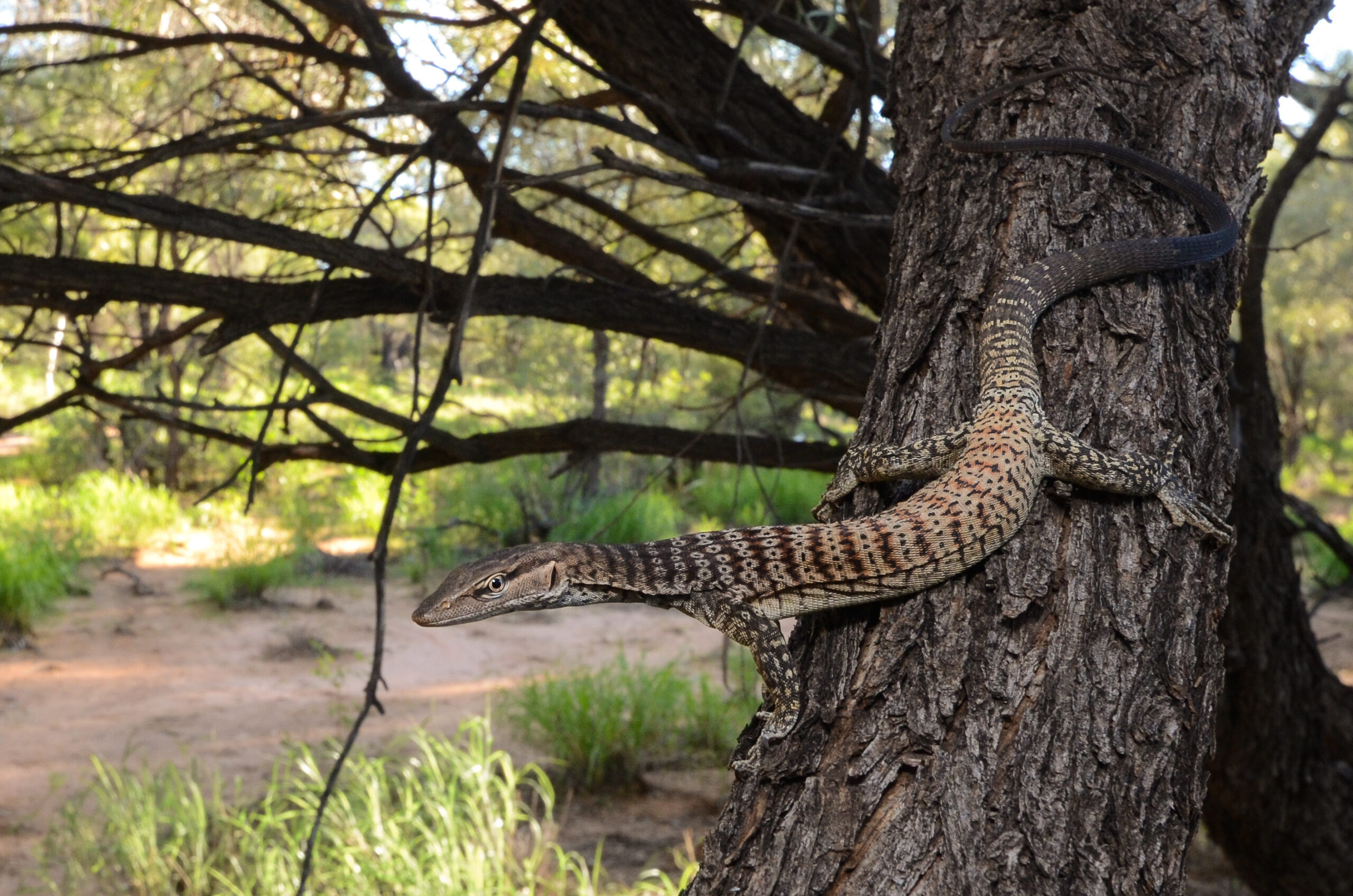
In the dry woodlands, rocky escarpments and arid shrublands of northern and central Australia, the Black-tailed Monitor (Varanus tristis) moves with sleek precision. More commonly known as the Black-headed monitor, it is a species of contrasts: cryptic and shy in some regions, bold and adaptable in others. Among Australia’s diverse monitors, it stands out for its variable appearance and its ability to thrive across a wide range of habitats.
Identification
The Black-tailed Monitor is a medium-sized species of goanna, typically reaching 70-90 cm in total length, with some individuals exceeding 1.2 m. Its appearance is highly variable, depending on locality. Colouration may be light brown to dark grey, with darker mottling or crossbands and some populations exhibit striking reticulated patterns. The tail is usually darker than the body, often black towards the tip – a key identifying feature. The body is slender with long limbs, a pointed snout and a forked blue tongue used to detect chemical cues. The tail is long, comprising more than half of its total length and is used both for balance and as a defensive whip.
Habitat and Distribution
Varanus tristis is widespread across northern, central and western Australia, occurring in a broad range of habitats including tropical savanna, desert shrublands, open woodlands and rocky gorges. Its distribution extends from the Pilbara and Kimberley regions of Western Australia, across the Northern Territory, into western Queensland and parts of South Australia. This broad range highlights its adaptability to both arid and semi-arid environments, as well as more tropical habitats.
Ecological Role
As a generalist carnivore, the Black-tailed Monitor occupies an important ecological niche. Its diet includes insects, reptiles, small mammals, birds and carrion. It is also known to raid bird nests for eggs and nestlings. By preying on a wide variety of species, it helps regulate populations of smaller animals and contributes to nutrient cycling through scavenging. In turn, young monitors are preyed upon by raptors, snakes and larger monitors, making them integral to multiple layers of the food web.
Behaviour and Reproduction
This species is diurnal and highly active, often seen basking on rocks or foraging across open ground. It is a strong climber and frequently ascends trees in search of prey or refuge. When threatened, it may hiss, inflate its body and lash its tail defensively. If cornered, it is capable of delivering a sharp bite with its recurved teeth.
Breeding occurs in the warmer months. Males engage in ritualised combat, grappling and wrestling in upright postures to establish dominance. Females lay clutches of 6-11 eggs in burrows, termite mounds, or other sheltered sites. The eggs incubate for several months before hatching, with young emerging as independent hunters from the outset.
Conservation Status
The Black-tailed Monitor is listed as a species of Least Concern across its range. It is widespread and adaptable, occupying many habitats where other reptiles may struggle to persist.
Threats
While not under significant conservation pressure, the species faces risks from habitat degradation due to land clearing, grazing and altered fire regimes. Road mortality is a common hazard in arid zones where monitors often bask on warm road surfaces. Predation by feral cats and foxes poses risks to juveniles. In some areas, illegal collection for the pet trade may also occur, though regulations exist to limit this practice.
Conservation Efforts
The widespread range of Varanus tristis overlaps with numerous national parks and reserves, providing habitat protection. Predator control programs targeting cats and foxes indirectly benefit the species. Continued public education about the ecological role of monitors helps reduce unnecessary persecution, as goannas are sometimes mistakenly seen as pests.
Final Thoughts
The Black-tailed Monitor is a reptile of adaptability and resilience, thriving in both the deserts and savannas of Australia’s interior. Its sharp intelligence, climbing ability and opportunistic diet make it one of the outback’s most resourceful predators. Protecting Varanus tristis means maintaining the balance of ecosystems where these agile hunters play their part, from rocky ridges to red sand plains.
Fauna Resources specialises in the safe handling of a range of different fauna species, through safe, effective and ethical fauna solutions. By providing dedicated fauna services, through passionate fauna spotter catchers and fauna specialists, we can support the unique terrestrial ecosystems and rich biodiversity Australia has to offer.
For more information about our specialist fauna services contact Fauna Resources today.