

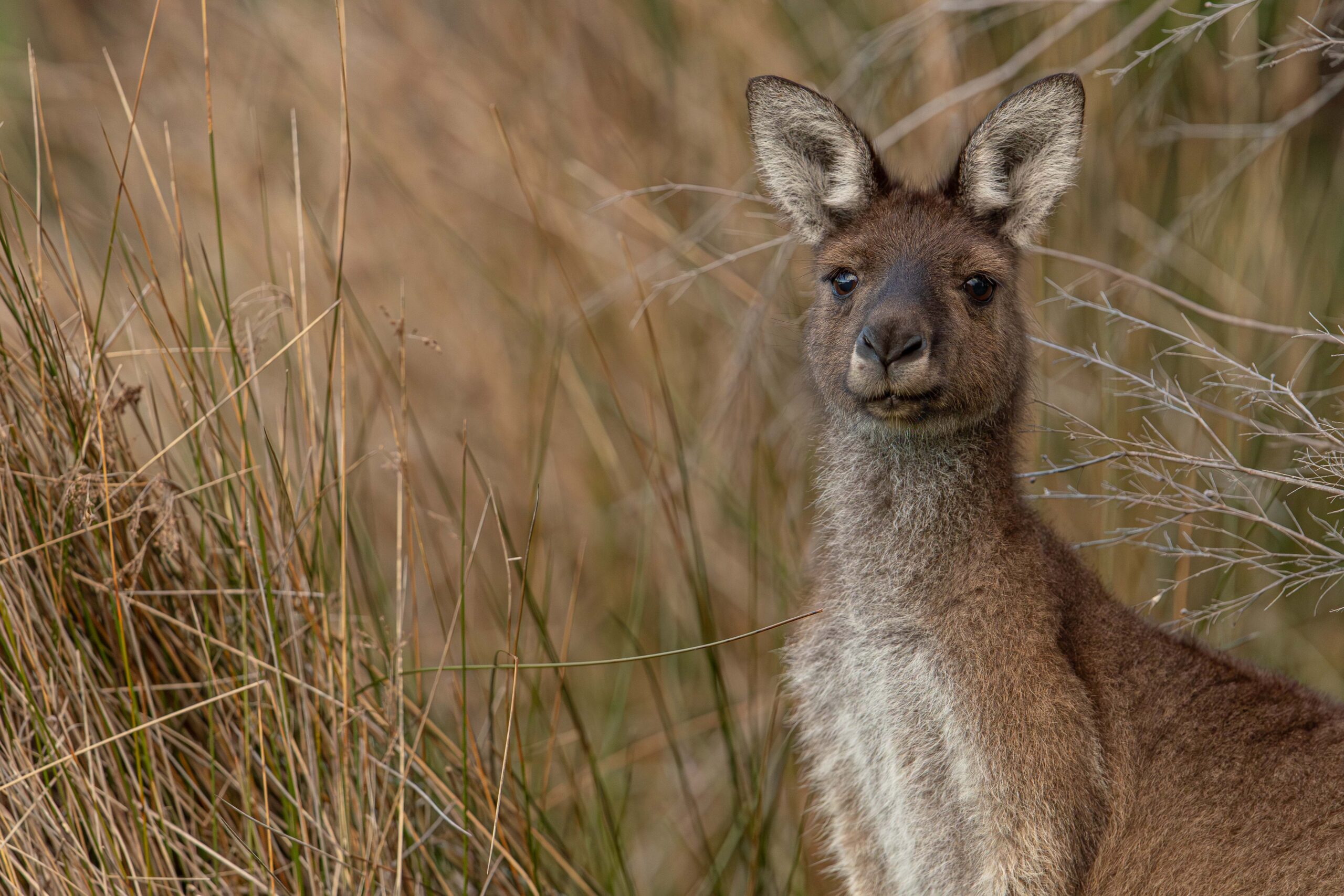
Across the open woodlands and grasslands of southern and western Australia, the Western Grey Kangaroo (Macropus fuliginosus) is a familiar sight. Often grazing in groups at dawn or dusk, these kangaroos are icons of the Australian bush, embodying both resilience and adaptability. Though less well-known internationally than the Red Kangaroo, the Western Grey is one of the most abundant and ecologically important large marsupials in its range.
Identification
The Western Grey Kangaroo is a large macropod, with males standing up to 2.2 metres tall and weighing 50-70 kg, while females are much smaller, usually under 30 kg. The fur is soft and thick, ranging from grey-brown to chocolate-brown, often paler on the underparts. Compared to the Eastern Grey Kangaroo, this species is generally darker and stockier. The muzzle is covered with fine hairs, unlike the bare muzzle of the Eastern Grey and males have a distinctive musky odour during the breeding season, earning them the nickname “stinker.” The powerful hind legs and long, muscular tail are used for hopping and balance, while the shorter forelimbs are used for feeding and grooming.
Habitat and Distribution
Macropus fuliginosus is widespread across southern Australia, ranging from coastal Western Australia through South Australia, into western Victoria and southern New South Wales. Its habitats include open eucalypt woodlands, shrublands, coastal heath, grasslands and agricultural land. The species has adapted well to landscapes modified by humans, often grazing on pasture alongside livestock. They are most active in the cooler parts of the day, resting in shade during the heat of midday.
Ecological Role
Western Grey Kangaroos are herbivores, grazing on grasses, forbs and shrubs. Their foraging influences plant community composition and helps shape groundcover structure. As prey, particularly in the past for dingoes and wedge-tailed eagles, they play a key role in predator-prey dynamics. Their grazing and movement across landscapes also contribute to soil disturbance and seed dispersal.
Behaviour and Reproduction
These kangaroos are social animals, usually seen in loose mobs that may number from a few individuals to over fifty, depending on habitat and resources. Mobs are fluid in composition, offering protection through collective vigilance. Males establish dominance hierarchies through ritualised sparring, using their forearms, tails and powerful kicks in combat displays.
Breeding occurs throughout the year, though peaks often coincide with favourable conditions. After a gestation of about 36 days, females give birth to a tiny, underdeveloped joey or “pinky”, which climbs unaided into the pouch to continue development. The joey remains in the pouch for around 9 months and continues suckling for several months after first leaving. Females are capable of embryonic diapause, pausing the development of a second embryo until the pouch young is ready to leave.
Conservation Status
The Western Grey Kangaroo is listed as a species of Least Concern under the Biodiversity Conservation Act 2016 (Western Australia). It remains widespread and abundant across much of its distribution in the state, occurring from coastal heathlands through to inland woodlands and open rangelands. In Western Australia, populations are managed through regulated harvesting and control programs in designated areas, primarily to reduce conflict with agriculture and to supply meat and hides under strict licensing conditions.
Threats
Although the Western Grey Kangaroo remains abundant in Western Australia, local populations face a number of pressures. Broadscale land clearing, particularly in the Wheatbelt, has fragmented native habitat and reduced the availability of food and shelter. Vehicle strikes are common in rural and regional areas, where kangaroos often graze near road verges. In heavily modified landscapes, they can also come into conflict with agriculture, competing with livestock for pasture or damaging crops. While juveniles may be vulnerable to predation from wedge-tailed eagles and dingoes, the greater risks today come from habitat fragmentation and human-related mortality.
Conservation Efforts
In Western Australia, the Department of Biodiversity, Conservation and Attractions (DBCA) manages Western Grey Kangaroo populations under the Biodiversity Conservation Act 2016. This includes regulated harvesting and control programs in designated management zones, ensuring that population numbers remain ecologically sustainable while reducing conflict with agricultural industries. The species also benefits from the state’s extensive network of national parks and conservation reserves, where it continues to thrive in secure habitats. Public education campaigns encourage safe driving in kangaroo-prone areas and promote awareness of the kangaroo’s role in maintaining ecosystem health.
Together, these measures help balance conservation needs with management responsibilities across the state.
Final Thoughts
The Western Grey Kangaroo is both ordinary and extraordinary – so common in some regions that it is taken for granted, yet remarkable as a symbol of adaptation and endurance. Its strong social bonds, unique reproductive biology and ecological role as a grazer make it one of Australia’s most important marsupials. Protecting Macropus fuliginosus means not only conserving an abundant species but also maintaining the delicate balance of the landscapes it has inhabited for millennia.
Fauna Resources specialises in the safe handling of a range of different fauna species, through safe, effective and ethical fauna solutions. By providing dedicated fauna services, through passionate fauna spotter catchers and fauna specialists, we can support the unique terrestrial ecosystems and rich biodiversity Australia has to offer.
For more information about our specialist fauna services contact Fauna Resources today.