

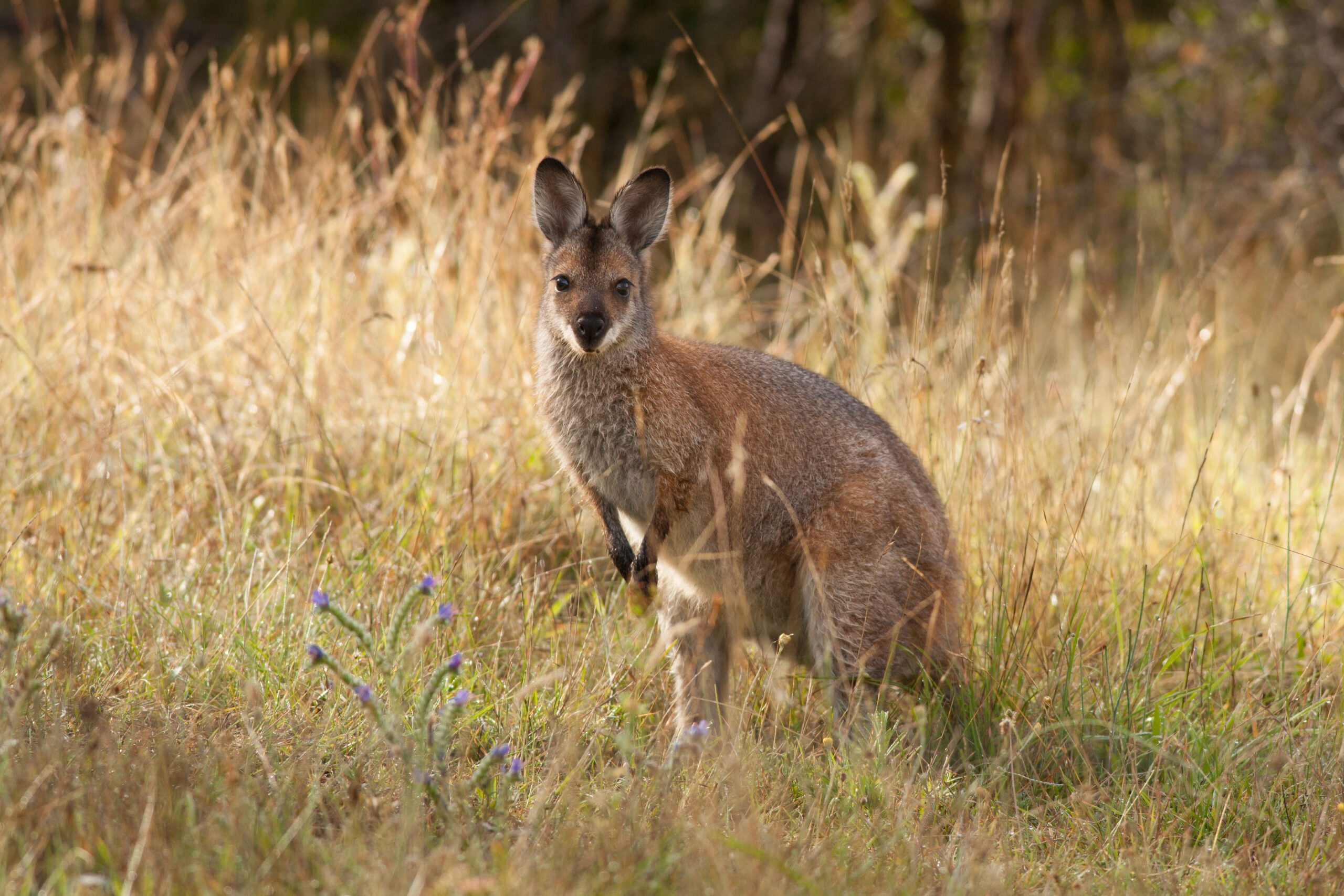
In the temperate forests, heathlands and coastal scrub of eastern and southeastern Australia, the Red-necked Wallaby (Notamacropus rufogriseus) is a common and familiar sight. Named for the rusty-red fur on its shoulders and nape, this medium-sized macropod is one of the most widely distributed wallabies in the country. It thrives in a range of environments, from dense forests to open farmland edges and is often seen grazing quietly at dusk and dawn.
Identification
The Red-necked Wallaby is medium-sized, standing about 70-90 cm tall, with a tail length of 65-85 cm. Males weigh 15-22 kg, while females are smaller, around 11-15 kg. Its fur is grey-brown overall with a reddish tinge across the shoulders and upper back, giving the species its name. The underparts are pale and the muzzle and paws are often dark. Its face is narrow with alert, rounded ears and the long, muscular tail provides balance when hopping. Compared with kangaroos, it is more compact and stocky in build.
Habitat and Distribution
Notamacropus rufogriseus is distributed along the eastern seaboard of Australia, from Queensland through New South Wales and Victoria into Tasmania. It is particularly common in Tasmania, where it is widespread and abundant and it also thrives in coastal and forested regions of Queensland and New South Wales. Habitats include open eucalypt forests, woodlands, heathlands and grasslands, often with dense understorey for shelter during the day. Red-necked Wallabies readily adapt to farmland edges and even peri-urban areas where cover remains nearby.
Ecological Role
As herbivores, Red-necked Wallabies play a role in shaping vegetation structure and influencing plant dynamics through grazing. They feed on grasses, herbs and shrubs, with diets varying seasonally depending on availability. By dispersing seeds and cycling nutrients, they contribute to the ecological processes of forests and woodlands. As prey, particularly for dingoes, eagles and historically thylacines in Tasmania, they form part of the predator-prey balance.
Behaviour and Reproduction
Red-necked Wallabies are mostly solitary or found in small, loose groups, unlike kangaroos which form larger mobs. They are crepuscular, being most active at dawn and dusk and spend the day resting in shaded cover. When threatened, they retreat into dense vegetation, using their agility to escape predators.
Breeding can occur year-round but peaks in summer. After a short gestation of about 30 days, the female gives birth to a single joey, which climbs into the pouch and attaches to a teat. The joey remains in the pouch for around 9 months and continues suckling after emerging until it is about 12-15 months old. Females are capable of embryonic diapause, allowing them to pause development of a second embryo until the pouch is free.
Conservation Status
The Red-necked Wallaby is listed as Least Concern under both the Biodiversity Conservation Act 2016 (Western Australia) for introduced populations in the southwest and the Nature Conservation Act 1992 (Queensland) for native populations. It is widespread and abundant across most of its range, with particularly high densities in Tasmania where it is sometimes regarded as overabundant.
Threats
While secure overall, the species faces localised threats. Habitat loss and fragmentation due to land clearing and urban development reduce available shelter and feeding grounds. Road mortality is a frequent issue, particularly in Tasmania and regional New South Wales. In agricultural areas, wallabies may be culled where they are perceived to compete with livestock for pasture. Predation by foxes, cats and dogs also impacts juveniles.
Conservation Efforts
As a common and secure species, the Red-necked Wallaby does not require targeted conservation measures. It benefits from extensive representation in protected areas, including national parks and reserves across eastern Australia and Tasmania. Population management is sometimes undertaken in regions where wallabies are considered overabundant, particularly in agricultural landscapes. Conservation emphasis is placed on balancing human-wildlife coexistence while ensuring habitat connectivity for healthy populations.
Final Thoughts
The Red-necked Wallaby is one of Australia’s most adaptable macropods – a quiet grazer of the forest edge, a resilient survivor of fragmented habitats and a vital part of the landscapes it inhabits. While secure overall, its story reminds us that even common species require thoughtful management to maintain the balance between human land use and native wildlife. Protecting Notamacropus rufogriseus ensures that this iconic wallaby continues to bound through Australia’s forests and fields, as it has for millennia.
Fauna Resources specialises in the safe handling of a range of different fauna species, through safe, effective and ethical fauna solutions. By providing dedicated fauna services, through passionate fauna spotter catchers and fauna specialists, we can support the unique terrestrial ecosystems and rich biodiversity Australia has to offer.
For more information about our specialist fauna services contact Fauna Resources today.