

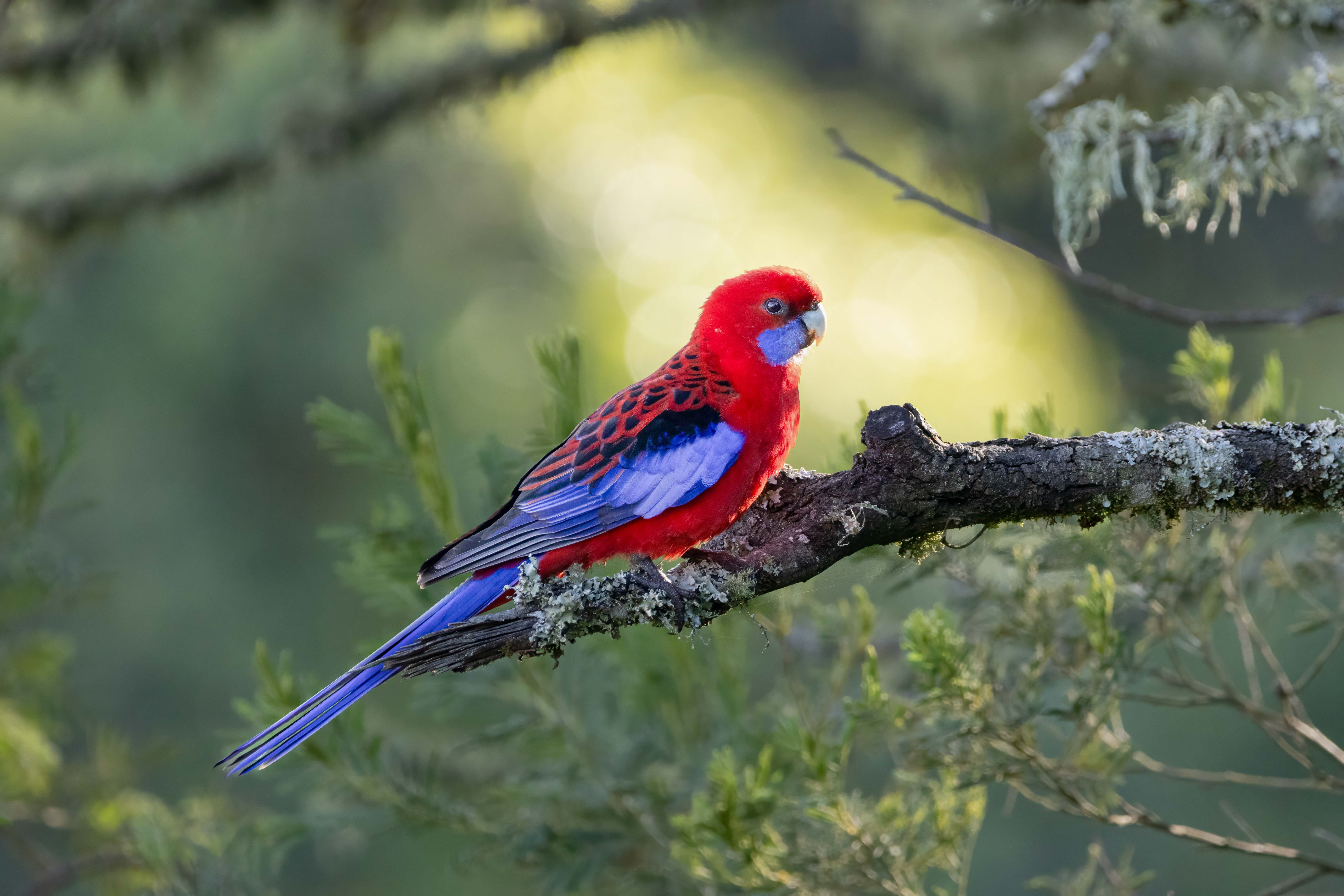

The Crimson Rosella (Platycercus elegans) is a bird of striking beauty, gracing Australia’s forests and gardens with its vivid plumage and melodic whistles. With a palette of deep scarlet and royal blue, this parrot is more than just a visual delight—it is an integral part of Australia’s woodland ecosystems. Found in various forms across eastern and south-eastern Australia, the Crimson Rosella has adapted well to both natural and human-altered environments, often seen foraging in the canopy or feeding on the ground with a calm confidence.
Identification
Adult Crimson Rosellas are medium-sized parrots measuring around 36 cm in length, with a long tail and robust build. The most distinctive feature is their brilliant crimson red head, breast and belly, offset by vibrant blue cheeks, wings and tail. The back features a scalloped black pattern, giving depth to the plumage. Subspecies vary in colouration slightly – such as the Adelaide Rosella, which is a blend of crimson and yellow. Juveniles are mostly green with patches of red and blue that gradually increase with age. Their call is a pleasant, high-pitched whistling note, often described as bell-like and far-carrying.
Habitat and Distribution
Crimson Rosellas are native to eastern and south-eastern Australia, occurring from northern Queensland through New South Wales and Victoria to South Australia and Tasmania. They are found in a wide range of habitats including wet sclerophyll forests, mountain ash forests, temperate rainforests, open woodlands and even urban parks and gardens. The species favours areas with abundant tree hollows and native flora, which provide both food and shelter. Its ability to adapt to modified environments has enabled it to thrive even near human settlements.
Ecological Role
As frugivores and nectarivores, Crimson Rosellas contribute significantly to seed dispersal and pollination. Their diet consists of seeds, berries, fruits, nectar and flowers from both native and introduced plants. They also consume insects and their larvae, especially when feeding young. This dietary diversity allows them to participate in multiple ecological interactions, supporting forest regeneration and controlling invertebrate populations. Their presence in diverse environments also makes them valuable indicators of local habitat health and floral diversity.
Behaviour and Reproduction
Crimson Rosellas are typically seen in pairs or small groups, although larger flocks may form outside of breeding season. They exhibit strong site fidelity and are often seen returning to the same roosting and feeding areas. Breeding occurs from September to January, depending on region. Nests are typically placed in tree hollows, often high in eucalypts or other mature trees. The female incubates a clutch of 4 to 8 eggs while the male feeds her. After hatching, both parents care for the chicks, which fledge around 5 weeks later. Juveniles remain with the parents for some time before dispersing.
Conservation Status
The Crimson Rosella is listed as Least Concern under both the Queensland Nature Conservation Act 1992 and the Western Australian Biodiversity Conservation Act 2016, where applicable. Its widespread distribution and adaptability have helped maintain stable populations throughout its range. However, subspecies or local populations in isolated habitats may require monitoring to ensure their long-term health.
Threats
While generally secure, local threats include habitat loss from land clearing, competition for nesting hollows with invasive species such as Common Mynas and European Starlings and illegal trapping for the pet trade. Urbanisation can also fragment populations and increase road mortality. Additionally, disease transmission from domestic birds in urban areas may pose a growing risk.
Conservation Efforts
Conservation of Crimson Rosellas focuses largely on habitat protection, particularly the preservation of mature trees that provide nesting hollows. Urban planning that integrates native vegetation corridors and supports biodiversity is also beneficial. Community awareness and responsible bird feeding practices can reduce the spread of disease and maintain ecological balance. Citizen science programs contribute valuable data on population trends and distribution.
Final Thoughts
The Crimson Rosella, with its dazzling colours and serene presence, is an icon of Australia’s forested landscapes. Its success in both wild and suburban settings highlights the importance of native habitat preservation and coexistence with wildlife. By protecting mature trees and promoting biodiversity in our gardens and reserves, we ensure that this charismatic parrot continues to brighten the canopy and enrich the acoustic backdrop of the Australian bush.
Fauna Resources specialises in the safe handling of a range of different fauna species, through safe, effective and ethical fauna solutions. By providing dedicated fauna services, through passionate fauna spotter catchers and fauna specialists, we can support the unique terrestrial ecosystems and rich biodiversity Australia has to offer.
For more information about our specialist fauna services contact Fauna Resources today.