

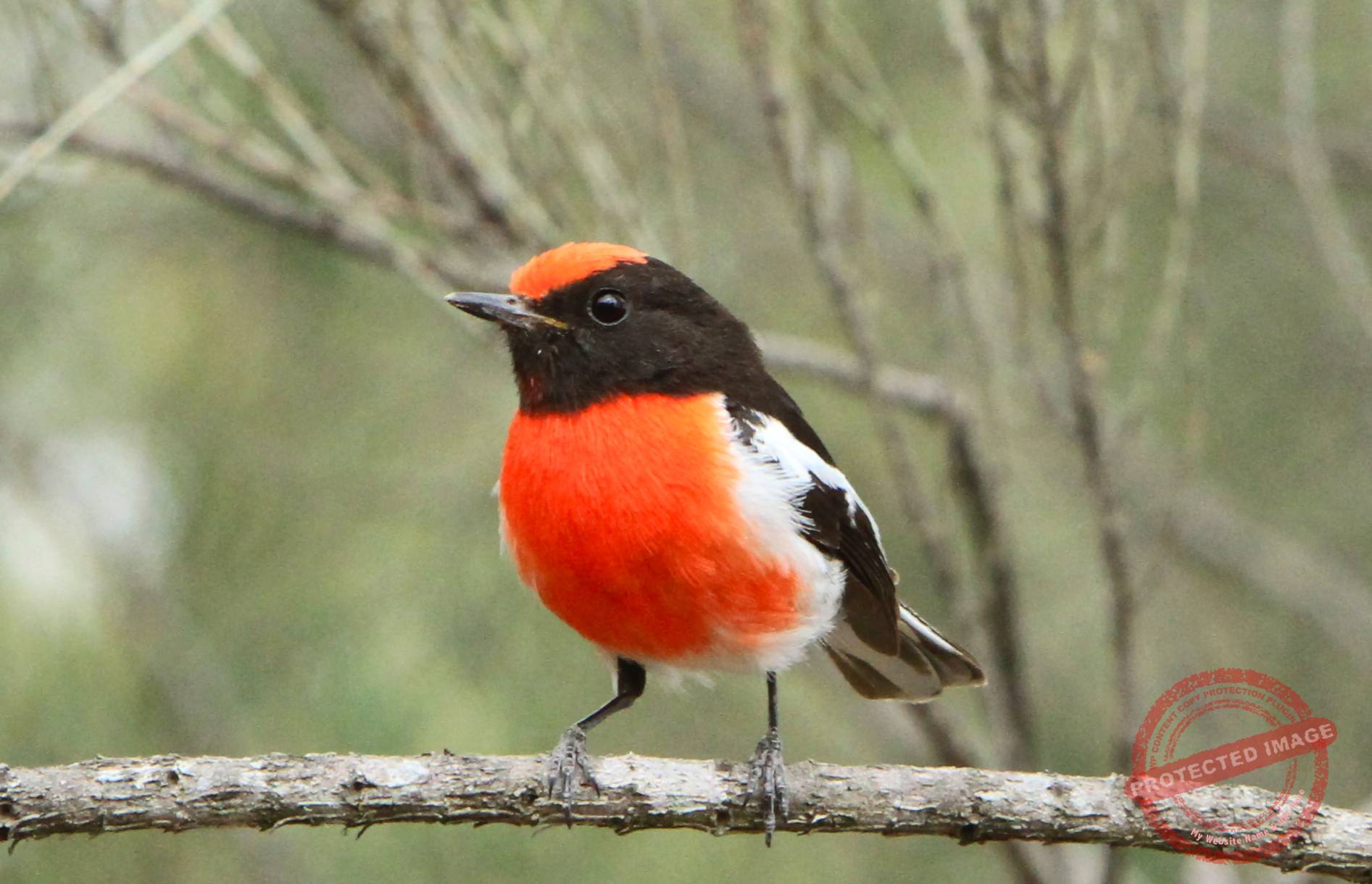
In the warm light of inland mornings, when the mulga casts long shadows across the red earth and the saltbush glints with dew, a flash of crimson flits across the low scrub. The Red-capped Robin is one of the most striking and endearing of Australia’s arid-zone songbirds. With its jet-black plumage and fiery red crown, it is a bird of bold contrast and quiet confidence. Though small in size, it commands attention wherever it appears, a flicker of colour among the greys and ochres of the dry country.
Identification
The male Red-capped Robin is unmistakable – dressed in velvet black with a scarlet crown and chest that glow like embers. White shoulder patches and a white belly add to the bold patterning. The female, by contrast, is softly coloured in pale brown tones with a light rufous tinge to the crown and breast and white underparts. Both sexes are around 10 to 12 centimetres in length, with a fine, pointed bill and large dark eyes that lend them a perpetually alert expression. Their posture is upright and lively, often flicking wings and tails as they perch on low branches or fence lines.
Habitat and Distribution
The Red-capped Robin is widely distributed across Australia’s drier interior, from inland Queensland and New South Wales to Western Australia, South Australia and the Northern Territory. It is found in semi-arid and arid woodlands, acacia shrublands, mulga country and mallee habitats. It favours open areas with sparse groundcover and scattered shrubs or trees, where it can perch and forage with ease. In Queensland, it is most commonly encountered in the Brigalow Belt, Mulga Lands and Channel Country bioregions, where remnant woodlands and lightly grazed landscapes provide suitable habitat. It is generally absent from dense forests and coastal areas.
Ecological Role
Red-capped Robins are insectivorous, feeding primarily on ground-dwelling and flying insects including beetles, grasshoppers, ants and spiders. They forage by perching low and scanning the ground for movement, then fluttering down to snatch prey before returning to the perch. This sit-and-wait strategy helps conserve energy in hot and resource-limited environments. By feeding on insects, the species helps regulate invertebrate populations and plays a subtle but important role in the health of arid ecosystems. In turn, it provides food for larger birds of prey and native predators.
Behaviour and Reproduction
These robins are generally seen singly or in pairs, with breeding pairs establishing and defending small territories during the nesting season. Courtship involves aerial chases and singing displays by the male, often perched in prominent positions with puffed-up chest and raised crest. The nest is a small, cup-shaped structure made of bark fibres, grass and spiderwebs, often placed in the fork of a low shrub or small tree. The female lays two to three eggs and performs most of the incubation and brooding duties, while the male assists in feeding the chicks once they hatch. The breeding season varies with rainfall and temperature but generally peaks from late winter through early summer. Outside of breeding, Red-capped Robins may form loose foraging groups and show some local movement in response to seasonal conditions.
Conservation Status
In Queensland, the Red-capped Robin is listed as Least Concern under the Nature Conservation Act 1992. It remains widespread across inland Australia, although local populations are sensitive to habitat loss and degradation. It is considered secure nationally, but some declines have been noted in heavily cleared regions or areas where native shrub layers have been removed. Because it is reliant on structurally complex woodlands with a mix of perches, groundcover and foraging zones, changes to fire regimes and grazing intensity can have a significant impact on its distribution.
Threats
Habitat fragmentation and vegetation clearing are among the main threats to the Red-capped Robin, especially in agricultural and pastoral landscapes. Removal of native shrubs and fallen timber reduces foraging and nesting opportunities. Overgrazing can degrade understorey structure and limit the availability of insect prey. Altered fire regimes, particularly frequent or intense burns, may also affect the density of shrubs and the availability of shelter. In some regions, predation by cats and nest disturbance by invasive species pose additional risks, particularly during the breeding season. While the species is adaptable to light disturbance, it is sensitive to the cumulative impacts of land use change.
Conservation Efforts
The Red-capped Robin benefits from general conservation actions that maintain woodland structure, encourage native vegetation regrowth and manage grazing intensity. Habitat protection in national parks, reserves and sustainably managed pastoral lands helps ensure the species continues to thrive in the wild. Restoration of native plant communities and the retention of fallen timber and low shrubs are also important for supporting local populations. Public awareness and birdwatching groups play a role in monitoring its presence and contributing valuable data to long-term ecological surveys.
Final Thoughts
The Red-capped Robin is a brilliant spark of colour in Australia’s interior – a songbird that reflects both the harshness and beauty of its environment. With each flit of red across the mulga, it reminds us that even the driest landscapes are rich with life and story. To conserve this species is to care for the quiet complexity of the bush – for the perches, the insects, the sheltering shrubs and the pairs that call to one another across still, sunlit mornings. In the subtle interplay of colour and habitat, the robin sings of balance – a balance worth preserving.
Fauna Resources specialises in the safe handling of a range of different fauna species, through safe, effective and ethical fauna solutions. By providing dedicated fauna services, through passionate fauna spotter catchers and fauna specialists, we can support the unique terrestrial ecosystems and rich biodiversity Australia has to offer.
For more information about our specialist fauna services contact Fauna Resources today.