

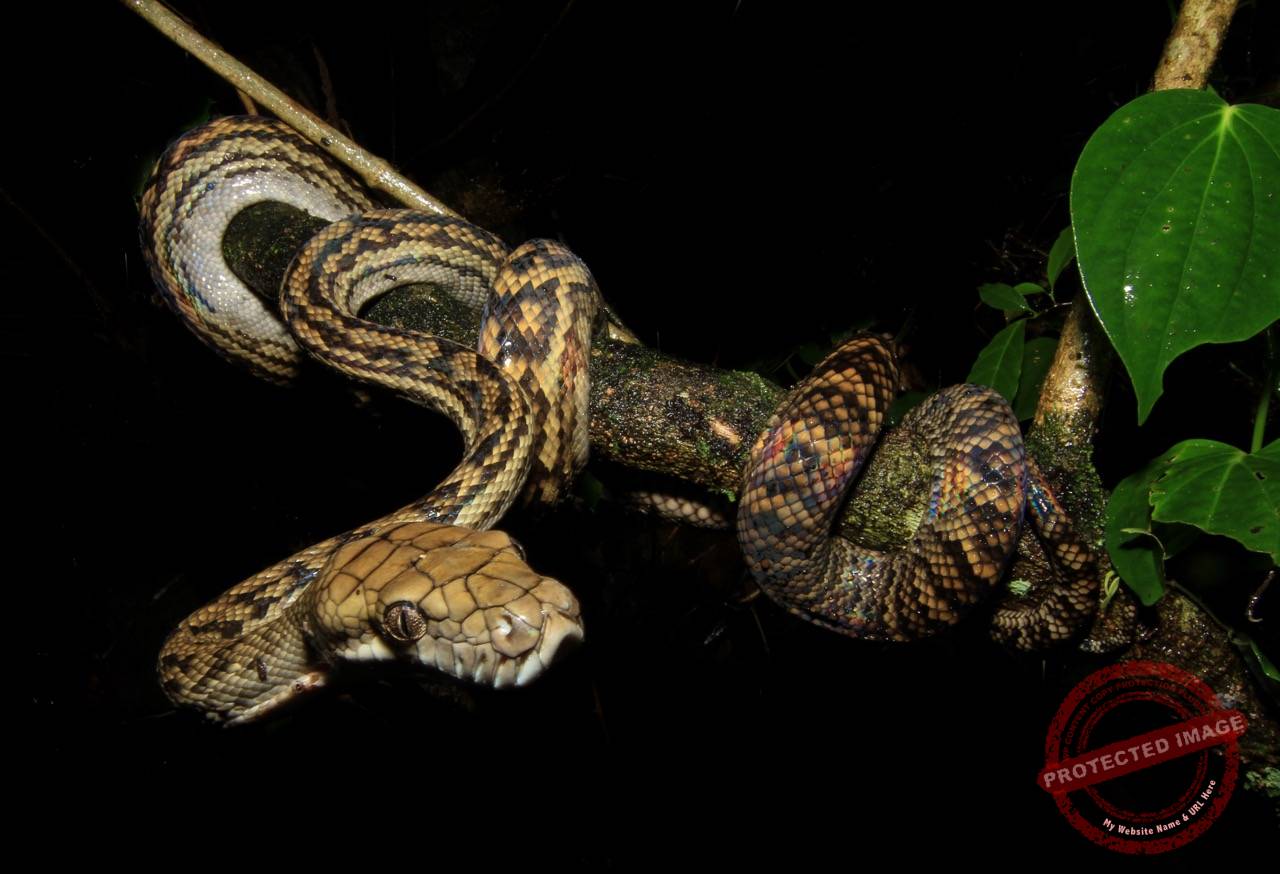
In the dense, humid rainforests and open woodlands of northern Australia, a giant moves unseen. Cloaked in iridescent scales that shimmer with hints of violet and bronze, the Amethystine python glides silently through leaf litter or coils among tree branches, a creature of both power and grace. As one of Australia’s largest snakes, this apex constrictor commands both awe and respect – its presence a testament to the wild, untamed essence of the tropics.
Identification
The Amethystine python, also known as the scrub python, is Australia’s largest native snake and among the longest in the world. Adults typically grow to lengths of 3-5 metres, though exceptional individuals may exceed 6 metres. Despite its formidable size, the species is non-venomous and typically shy in nature.
Its body is patterned with intricate, irregular dark markings over a background of olive, brown or yellow-bronze. When caught in sunlight, its scales refract a violet-blue sheen – giving rise to its name. The head is angular and distinct from the neck, with heat-sensitive pits along the jaw that allow it to detect warm-blooded prey even in complete darkness.
Habitat and Distribution
The Amethystine python inhabits a range of environments across far north Queensland, from the tropical rainforests of the Wet Tropics to the open eucalypt forests and rocky outcrops of Cape York Peninsula. It is most often associated with rainforest edges, riparian corridors, and areas with high prey abundance.
Though also found in New Guinea and parts of Indonesia, the Australian population of Simalia kinghorni is geographically and ecologically distinct. Within Queensland, it is widely distributed across the Cape York and Wet Tropics bioregions.
Ecological Role
As a top predator, the Amethystine python plays a vital ecological role in controlling populations of birds, mammals and reptiles. Its diet includes rodents, possums, flying foxes, and ground-dwelling birds, making it an important regulator of trophic dynamics within its habitat. It hunts primarily by ambush, using its muscular coils to subdue prey swiftly and efficiently.
This python is also semi-arboreal and an excellent swimmer, giving it access to a broad range of ecological niches. It is active mostly at night, often sheltering in hollow logs, tree hollows or beneath dense foliage during the day.
Conservation Status
According to the Queensland Department of Environment, Science, Tourism and Innovation (DETSI), the Amethystine python is listed as Least Concern under the Nature Conservation Act 1992. Its population is considered stable, and it occurs across a broad range in northern Queensland. However, its large size and proximity to human settlements can bring it into conflict with people, leading to unwarranted persecution or relocation.
Although not currently considered at risk, its dependency on healthy ecosystems means that habitat loss and fragmentation – especially in the Wet Tropics – could pose future threats if not carefully managed.
Threats
While the species is widespread, localised pressures exist. Habitat clearing for agriculture and development can displace individuals, reduce prey availability, and increase mortality due to road traffic. Misunderstanding and fear often lead to deliberate killing, despite its protected status.
Introduced predators and invasive species, such as feral pigs and cane toads, may alter the balance of the ecosystems in which this python resides, although the full extent of these impacts remains under study. Additionally, illegal collection for the pet trade, while relatively uncommon in Australia, is a potential concern in neighbouring countries within the species’ broader range.
Cultural Significance
Snakes have deep cultural and spiritual meaning for many Aboriginal communities across northern Australia. Pythons in particular, often seen as protectors and bringers of rain, are associated with powerful ancestral beings. In some traditions, the Amethystine python is regarded as a totemic animal – its movements, habits and presence in Country seen as messages or signs from the Dreaming.
Respect for these beings is tied to law, story and land, and reinforces the importance of living in harmony with all native creatures.
Conservation Efforts
Though not currently threatened, the Amethystine python benefits from legal protection under Queensland legislation, as well as the presence of extensive conservation reserves across its range. Continued public education is key to reducing human-wildlife conflict and ensuring that large, non-venomous snakes like this one are not needlessly harmed.
Partnerships with Traditional Owners and conservation groups have also improved habitat management and species monitoring across parts of the Cape York and Wet Tropics regions.
Final Thoughts
The Amethystine python is more than just Australia’s largest snake – it is a living emblem of ecological resilience, quiet power and rainforest mystery. To encounter one is to witness a creature perfectly adapted to its world: patient, precise, and profoundly ancient. By protecting this magnificent species and the habitats it calls home, we honour not only a remarkable reptile, but the wild landscapes that define northern Australia.
Fauna Resources specialises in the safe handling of a range of different fauna species, through safe, effective and ethical fauna solutions. By providing dedicated fauna services, through passionate fauna spotter catchers and fauna specialists, we can support the unique terrestrial ecosystems and rich biodiversity Australia has to offer.
For more information about our specialist fauna services contact Fauna Resources today.