

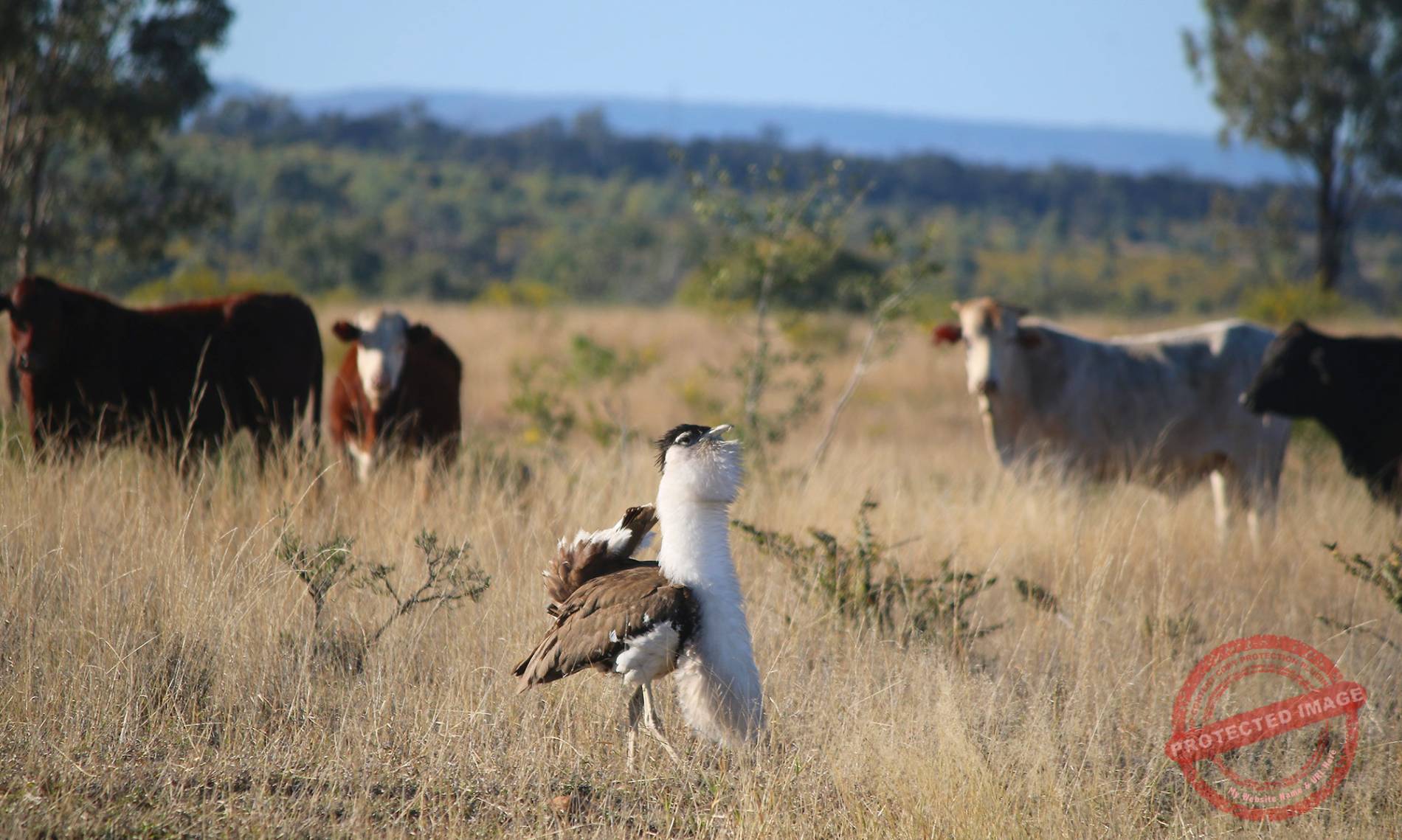
Across the expansive plains and savannas of northern and inland Australia, the Australian Bustard stands as a magnificent figure – tall, regal and easily visible against the horizon. With its impressive size, wide wingspan and slow, deliberate movements, this bird of the open grasslands commands respect. Once widespread throughout the country, the Australian Bustard now faces significant challenges that have reduced its range, particularly in southern Australia. Despite these threats, it remains an iconic species of the Australian outback.
Identification
The Australian Bustard is one of the largest terrestrial birds in Australia, with males reaching up to 1.2 metres in height and possessing a wingspan that can exceed 2.3 metres. Their plumage is a mix of rich browns, greys and whites, providing camouflage in their open grassland and woodland habitats. During the breeding season, males perform elaborate courtship displays, inflating their necks and calling with deep booming sounds to attract mates.
Although it may appear slow-moving, the Australian Bustard can take flight with powerful wingbeats when startled, soaring long distances across the open land. Its long neck, pointed beak and large, muscular legs make it a distinctive figure among Australia’s avian fauna.
Habitat and Distribution
The Australian Bustard is found across much of northern Australia, ranging from the Kimberley region in Western Australia to Cape York Peninsula and the Top End of the Northern Territory. It is most commonly associated with open savannas, grasslands and lightly timbered areas, where it can forage and breed without the dense cover of heavy forests.
Historically, it was more widespread, occurring across much of southern Australia. However, due to habitat destruction, hunting and other pressures, the bustard has become less common in many parts of its former range, particularly in the south.
Ecological Role
An opportunistic omnivore, the Australian Bustard plays a crucial role in its ecosystem. Its diet includes a wide variety of food, such as seeds, insects, small mammals and reptiles. Grasshoppers, beetles and even small reptiles like lizards make up a significant part of its diet during the wet season, when food is abundant.
The bustard is a ground-dwelling species that forages alone or in small groups. With its excellent vision and large size, it is able to detect and capture a wide range of prey. Its activities help regulate insect populations and contribute to seed dispersal, further embedding it in the ecological balance of its habitat.
Conservation Status
The Australian Bustard is listed as Least Concern under the Queensland Nature Conservation Act 1992 by the Queensland Department of the Environment, Tourism, Science and Innovation (DETSI). While populations are generally stable in parts of northern Australia, the species faces ongoing threats due to habitat loss, altered fire regimes and the pressures of introduced predators such as foxes and cats. Although its status in Queensland is secure, the Australian Bustard is considered Endangered or Critically Endangered in other regions of Australia, such as New South Wales and Victoria, due to habitat fragmentation and overhunting in the past.
This listing reflects the species’ overall distribution and population trends, which have experienced declines in southern Australia, particularly where habitat conversion for agriculture and urban development has been widespread. Despite its Least Concern status in Queensland, conservation efforts are still vital to maintaining healthy populations in both protected and unprotected areas.
Threats
Key threats to the Australian Bustard include habitat loss and fragmentation, primarily from agriculture, urban expansion and mining, which reduces the available open space for foraging and breeding. Altered fire regimes, as inappropriate or out-of-season fires can destroy nesting sites and disrupt the food sources bustards rely on.
Grazing by livestock, which can trample nests and reduce the availability of ground cover and food. Predation by introduced species, such as feral cats and red foxes, which prey on eggs, chicks and sometimes adult bustards. Road mortality, especially in remote areas where the bustards may be drawn to road verges, increasing their risk of being hit by vehicles.
Although hunting pressures have largely diminished, past practices, particularly in the southern regions of Australia, severely impacted the population.
Cultural Significance
For many Aboriginal communities across northern Australia, the Australian Bustard is a culturally significant species. It holds importance in various Dreaming stories and is often associated with seasonal food sources. Known by different names in various Indigenous languages, it has been traditionally hunted for its meat, which is considered a prized delicacy.
The bustard’s significance extends beyond sustenance, representing a connection to Country and the natural rhythms of the land. Traditional ecological knowledge is crucial in understanding the best practices for sustainable hunting and land management to protect this important bird.
Conservation Efforts
In Queensland, the Australian Bustard benefits from a combination of legal protection and habitat preservation through national parks and wildlife reserves. Conservation efforts focus on maintaining and enhancing suitable habitats, controlling feral predators and managing fire regimes. Monitoring programs and community involvement in conservation, especially with Indigenous groups, are key to ensuring the species’ continued survival in the region.
In other states where the bustard faces more severe threats, efforts are focused on habitat restoration and addressing the impacts of agriculture and land-use changes.
Final Thoughts
The Australian Bustard remains an iconic symbol of Australia’s vast, open spaces. Although its range has contracted in some parts of the country, it continues to thrive in northern Australia’s grasslands and savannas. By ensuring ongoing habitat protection and management, we can help secure the future of this remarkable bird, preserving not only its place in Australia’s wildlife but also the ecosystems it inhabits.
Fauna Resources specialises in the safe handling of a range of different fauna species, through safe, effective and ethical fauna solutions. By providing dedicated fauna services, through passionate fauna spotter catchers and fauna specialists, we can support the unique terrestrial ecosystems and rich biodiversity Australia has to offer.
For more information about our specialist fauna services contact Fauna Resources today.