

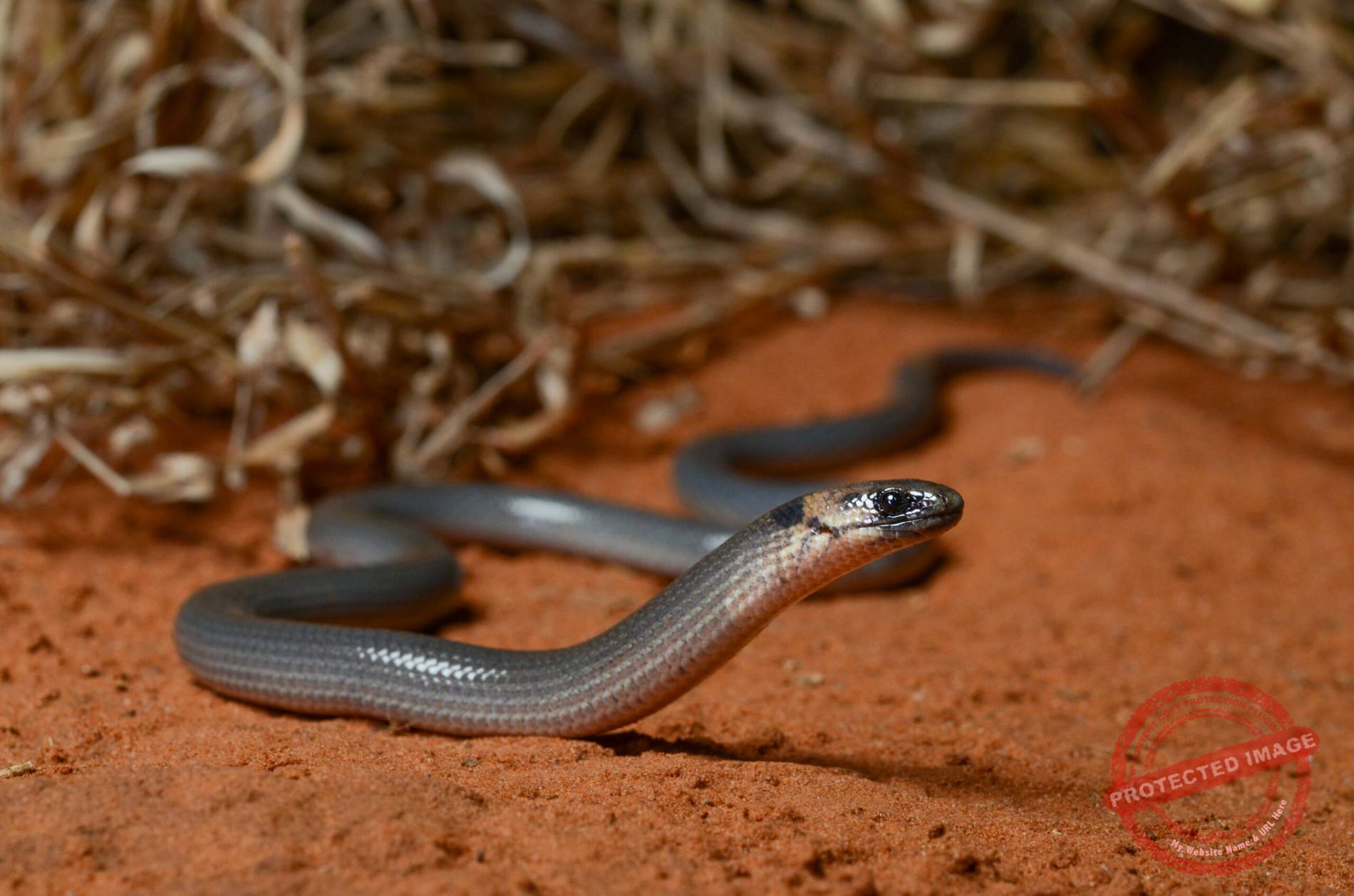
In the quiet understories of central Queensland’s brigalow woodlands, where ironbark and acacia form tangled mosaics, the Brigalow Scaly-foot (Paradelma orientalis) glides silently across the leaf litter. Legless but not a snake, this rare lizard belongs to the gecko family, distinguished by its scales and unique ecology. Seen only occasionally at night, it is a hidden inhabitant of a vanishing habitat – a reptile whose very existence reflects both the fragility and resilience of Australia’s woodland ecosystems.
Identification
The Brigalow Scaly-foot is a slender, elongate lizard reaching around 16 to 20 cm in length. Its appearance is superficially snake-like, though it retains vestigial hindlimb flaps near the cloaca – the “scaly feet” from which it takes its common name. The body is smooth and glossy, with scales that shimmer in shades of grey-brown to olive, often with faint darker flecking. The head is distinct, with a narrow snout and large, expressive eyes adapted for nocturnal foraging. Unlike snakes, it possesses external ear openings and a fleshy, unforked tongue. The tail is long and fragile, capable of autotomy (self-amputation) if threatened.
Habitat and Distribution
Endemic to Queensland, Paradelma orientalis is restricted to the brigalow (Acacia harpophylla) ecosystems of the Brigalow Belt, particularly in the central inland. It is strongly associated with remnant dry sclerophyll woodlands and brigalow scrubs, often sheltering beneath logs, rocks or deep leaf litter during the day. At night, it emerges to forage on the forest floor. Its distribution is highly fragmented due to extensive land clearing for agriculture and many populations now persist only in isolated woodland remnants and protected reserves.
Ecological Role
The Brigalow Scaly-foot plays a specialised role in its ecosystem, feeding primarily on soft-bodied invertebrates such as snails, slugs and insects. This makes it an important regulator of invertebrate populations within brigalow woodlands. In turn, it is preyed upon by owls, snakes and introduced predators such as cats and foxes. Its nocturnal activity and sensitivity to habitat integrity make it an important bioindicator of woodland ecosystem health.
Behaviour and Reproduction
Nocturnal and secretive, the Brigalow Scaly-foot spends daylight hours concealed under logs or debris, emerging at night to forage. Its movement is slow and deliberate compared to snakes, with a characteristic gecko-like gait. When threatened, it may thrash and shed its tail to distract predators. Unlike most other scaly-foots, Paradelma orientalis is ovoviviparous – females give birth to live young, usually one or two offspring at a time. This reproductive mode is thought to be an adaptation to the unpredictable climates of its arid-woodland habitat.
Conservation Status
The Brigalow Scaly-foot is listed as Vulnerable under the Queensland Nature Conservation Act 1992 due to its restricted distribution and the ongoing decline of brigalow ecosystems. It is considered one of the more range-restricted and habitat-dependent legless lizards in Australia.
Threats
The greatest threat to Paradelma orientalis is habitat loss. Brigalow woodlands have been extensively cleared for cropping and grazing, leaving less than 10% of their pre-European extent intact. Remaining habitats are often small, fragmented and degraded by invasive weeds, altered fire regimes and soil compaction from livestock. Introduced predators such as cats and foxes pose additional risks, particularly to juveniles. Road mortality also occurs where remnant woodlands border agricultural or transport corridors.
Conservation Efforts
Conservation of the Brigalow Scaly-foot is closely tied to the protection and restoration of brigalow ecosystems. Efforts include securing remnant habitats in reserves, fencing to exclude grazing and replanting brigalow and associated woodland vegetation. Predator control programs in key reserves help reduce pressure from cats and foxes. Scientific surveys and citizen science initiatives continue to improve understanding of its distribution and ecological needs. Legislative protections under Queensland and federal law aim to prevent further habitat loss.
Final Thoughts
The Brigalow Scaly-foot is a ghost of the woodlands – quiet, cryptic and increasingly rare. Its survival depends on the fate of the brigalow forests, one of Australia’s most threatened ecosystems. To conserve Paradelma orientalis is to safeguard not only a unique reptile, but an entire ecological community that whispers of Australia’s deep evolutionary past and fragile environmental future.
Fauna Resources specialises in the safe handling of a range of different fauna species, through safe, effective and ethical fauna solutions. By providing dedicated fauna services, through passionate fauna spotter catchers and fauna specialists, we can support the unique terrestrial ecosystems and rich biodiversity Australia has to offer.
For more information about our specialist fauna services contact Fauna Resources today.