

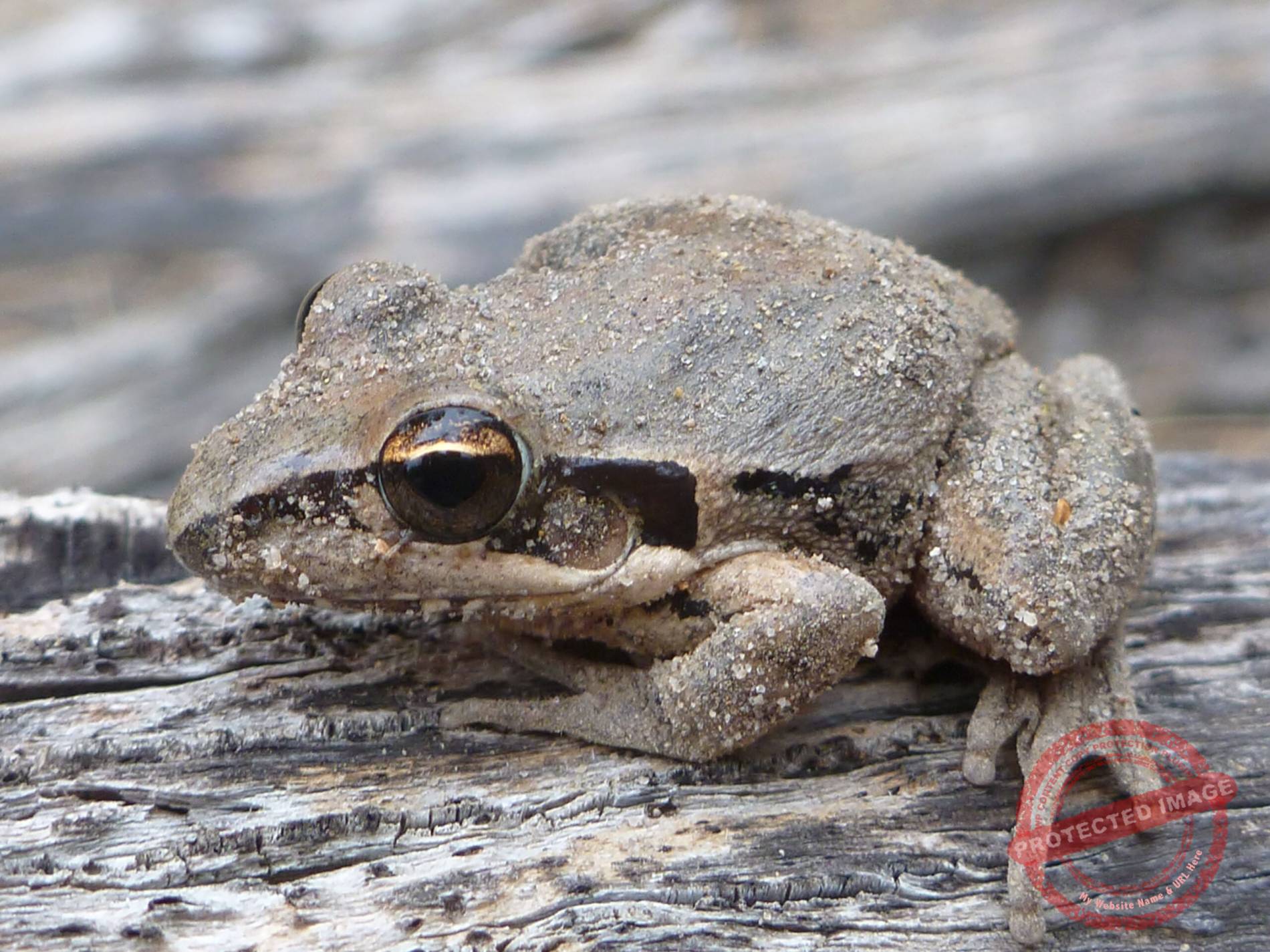
When heavy rains sweep across the dry woodlands and grasslands of eastern Australia, the bush comes alive with movement and sound. One of the first voices to rise from the flooded drains, temporary pools, and shallow wetlands is a sharp, duck-like “quark” – the unmistakable call of the Broad-palmed Frog. This small, adaptable amphibian waits patiently underground for the storm’s arrival, emerging in large numbers to feed, sing, and breed. It is a specialist in seizing short-lived opportunity, a creature finely tuned to the rhythm of Australia’s boom-and-bust climate.
Identification
The Broad-palmed Frog is modest in size, usually growing no more than 4.5 centimetres in length. Its colouring varies between pale grey and sandy brown, with darker patches or flecks scattered across the back. A dark stripe runs from the snout through the eye and down the flank, often interrupted by a pale bar near the eye. Its underbelly is white and granular, and the inner thighs are vividly marked with yellow and black. The webbing between the toes and fingers is broad – an adaptation reflected in its name and well suited for swimming in shallow water. Though relatively plain in appearance, it becomes far more conspicuous when heard calling in chorus during the breeding season.
Habitat and Distribution
This frog has a wide distribution across eastern Australia, from central Queensland down into southern New South Wales. It prefers open habitats such as grassy woodlands, dry sclerophyll forests, floodplains, and cleared farmland. Rather than relying on permanent water, the Broad-palmed Frog seeks out ephemeral pools, roadside ditches, flooded tracks, and temporary creeks that appear after rain. It can be found far from water for most of the year, buried under soil or leaf litter in a state of dormancy, waiting for the next downpour to reanimate the landscape.
Ecological Role
As both predator and prey, the Broad-palmed Frog is an important part of the ecosystems it inhabits. It helps regulate insect populations, feeding on ants, beetles, flies, and spiders. During its breeding booms, it provides a valuable food source for snakes, birds, and mammals. Its tadpoles also play a role in aquatic food webs, grazing on algae and detritus and becoming prey for larger aquatic animals. In this way, the Broad-palmed Frog connects land and water, contributing to the circle of life within its environment.
Behaviour and Breeding
This species breeds opportunistically following significant rainfall. Males gather near shallow water and begin calling – their voices forming a chorus that attracts females to the site. Eggs are laid in small clumps, often attached to submerged plants or left floating freely. Tadpoles hatch within a few days and grow quickly, undergoing metamorphosis in as little as six to eight weeks, depending on temperature and water levels. The juveniles disperse soon after emerging, seeking refuge in the surrounding vegetation and soil.
The Broad-palmed Frog is mostly nocturnal and avoids daytime heat by hiding in cool, moist microhabitats. It has adapted well to disturbance and is commonly found in agricultural areas and urban edges, provided suitable breeding sites and shelter are available.
Conservation Status
The Broad-palmed Frog is listed as Least Concern under the Queensland Nature Conservation Act 1992. It is also considered secure in New South Wales. Its wide distribution, adaptability to disturbed environments, and use of temporary water sources contribute to its stable status. The species is not currently recognised as threatened in any Australian jurisdiction. However, because it depends on rainfall and seasonal wetlands for breeding, its success can vary significantly from year to year, and local populations may still be vulnerable to changes in land use or climate.
Threats
The main threats to the Broad-palmed Frog are linked to habitat alteration. Clearing of vegetation, loss of wetland areas, and soil compaction reduce the availability of both breeding sites and shelter. Changes in rainfall patterns due to climate change may lead to fewer suitable breeding opportunities. Agricultural chemicals and pollutants can contaminate breeding pools, affecting eggs and tadpoles. Predation by introduced species such as foxes, cats, and cane toads adds further pressure, particularly during vulnerable stages of the life cycle. While the species is not in immediate danger, these cumulative impacts could influence local population trends over time.
Conservation Efforts
Although no species-specific recovery programs are in place, the Broad-palmed Frog benefits from general amphibian conservation measures. These include wetland protection, feral predator control, and public education campaigns aimed at fostering frog-friendly practices in rural and suburban areas. Citizen science platforms like FrogID have helped raise awareness of this and many other frog species, providing valuable data on distribution, breeding activity, and habitat use across its range.
Final Thoughts
The Broad-palmed Frog may not be flashy or famous, but it plays a quiet and consistent role in Australia’s dynamic landscapes. It is a survivor of the seasonal flood, a messenger of rain, and a contributor to the health of ecosystems both natural and human-altered. In listening to its call echo across the wet grass after summer rain, we hear not just a frog, but a signal that life is once again stirring in the soil, water, and air. Protecting species like this ensures the continuation of nature’s smaller, vital rhythms – the kind that keep ecosystems humming, quietly and steadily, beneath our notice.
Fauna Resources specialises in the safe handling of a range of different fauna species, through safe, effective and ethical fauna solutions. By providing dedicated fauna services, through passionate fauna spotter catchers and fauna specialists, we can support the unique terrestrial ecosystems and rich biodiversity Australia has to offer.
For more information about our specialist fauna services contact Fauna Resources today.