

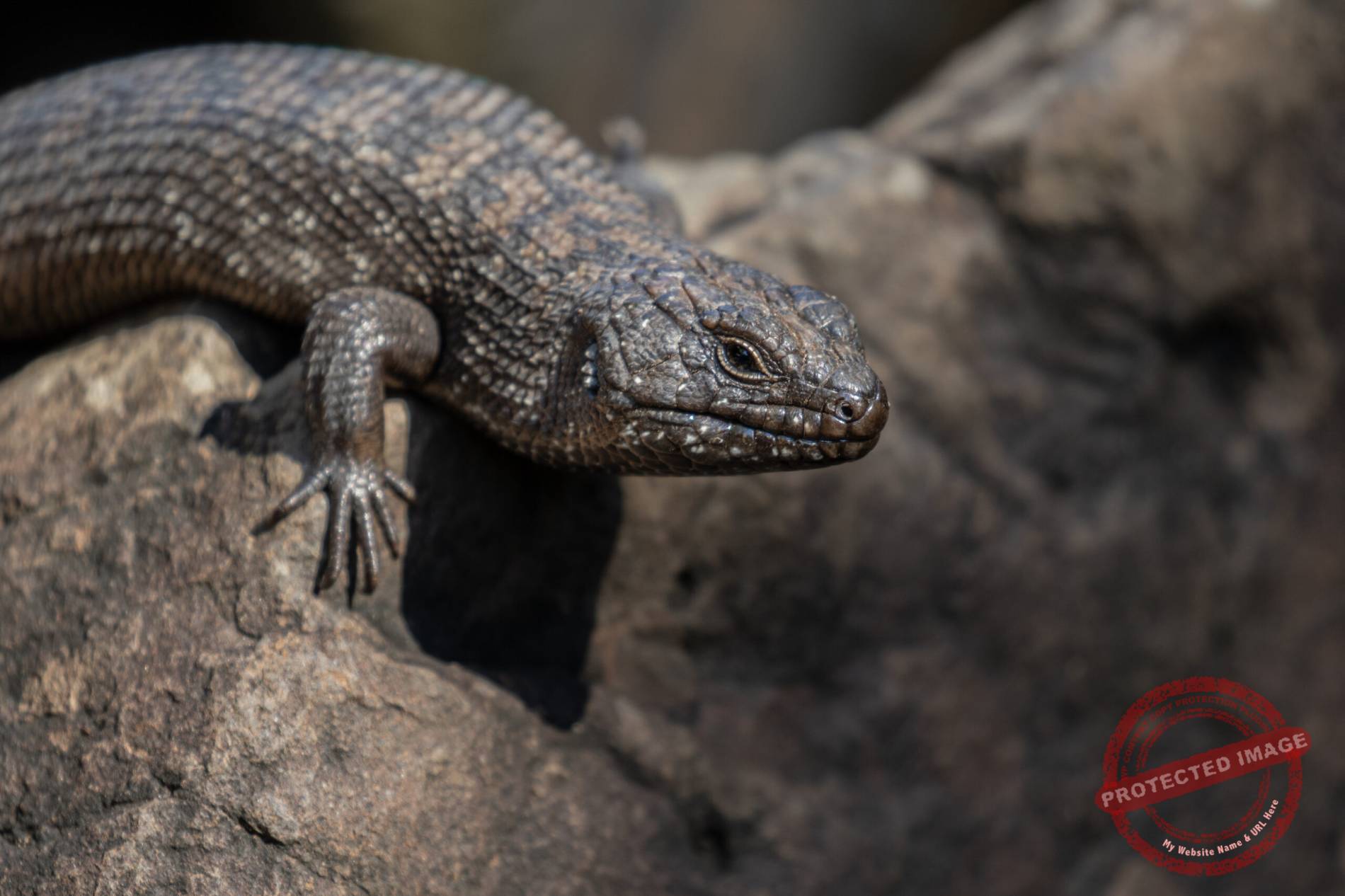
Basking on rocky outcrops and darting between crevices, the Cunningham’s skink (Egernia cunninghami) is one of Australia’s most charismatic and robust reptiles. Named after the early 19th-century explorer Allan Cunningham, this large skink is a familiar sight in rocky habitats of southeastern Australia. Its presence adds a sense of vitality to the sunlit slopes and escarpments where it thrives, embodying both the resilience of the landscape and the complex social lives of lizards.
Identification
Cunningham’s skink is a large, heavily built lizard, typically reaching 25 to 40 cm in total length. Its dorsal scales are strongly keeled, giving it a rough texture and an almost spiny appearance. Colouration is variable, but individuals are generally patterned in shades of grey, brown and black, often with mottling or bands that provide excellent camouflage among rocks. The ventral surface is lighter, usually pale grey or cream. The head is broad with a blunt snout and the limbs are strong with sharp claws adapted for climbing and gripping rock surfaces. When threatened, the skink may wedge itself into a crevice, making use of its rough scales to resist extraction by predators.
Habitat and Distribution
Egernia cunninghami occurs across southeastern Australia, including New South Wales, Victoria and parts of South Australia and the ACT. It is strongly associated with rocky escarpments, outcrops and slopes, favouring habitats with abundant sun-exposed rocks interspersed with crevices for shelter. Populations also occur in semi-arid woodlands, heathlands and even suburban parklands where suitable rocky habitat is present. The species is primarily terrestrial but is an adept climber, using both ground-level and elevated basking sites.
Ecological Role
As an omnivore, Cunningham’s skink has a broad diet that includes insects, snails and small vertebrates, as well as a significant proportion of plant matter such as fruits, flowers and leaves. This varied diet allows it to influence both invertebrate populations and seed dispersal in its habitat. In turn, it serves as prey for raptors, snakes and introduced predators such as foxes and cats. Its role as both predator and seed disperser underscores its ecological importance in rocky ecosystems.
Behaviour and Reproduction
Unusually for reptiles, Cunningham’s skink exhibits complex social behaviour. It often forms stable colonies where multiple individuals share overlapping home ranges and use the same network of crevices. These colonies may include extended family groups, with strong site fidelity. When basking, the skinks are alert and quick to retreat if disturbed, but within colonies they often engage in cooperative behaviours, such as shared basking and mutual defence of shelter sites.
Reproduction is viviparous, with females giving birth to live young rather than laying eggs. Litters usually contain 2 to 6 offspring, born in late summer. The young often remain within their natal colony, enhancing the cooperative social structure. Sexual maturity is reached at around 2 to 3 years of age and individuals may live for more than 10 years in the wild.
Conservation Status
The Cunningham’s skink is listed as a species of Least Concern across its range. It is relatively common in suitable rocky habitats and shows adaptability to some human-modified landscapes where rocks and shelter remain intact.
Threats
While secure overall, the species faces local threats from habitat loss due to land clearing, quarrying and urban development, which can reduce the availability of rock outcrops and crevices. Predation by feral cats and foxes is a significant concern, especially for juveniles. In some areas, illegal collection for the pet trade has also impacted local populations. Altered fire regimes can further affect shelter availability and food resources.
Conservation Efforts
Much of the Cunningham’s skink’s range overlaps with national parks and conservation reserves, which provide protection for its rocky habitats. Conservation priorities include maintaining rocky outcrop integrity, controlling invasive predators and preventing illegal collection. Public education about the ecological importance and unique social structure of this skink also supports its conservation. Citizen science surveys contribute to monitoring distribution and population health.
Final Thoughts
The Cunningham’s skink is more than just a sun-loving reptile – it is a social creature, a seed disperser and a sentinel of rocky slopes and escarpments. Its resilience in the face of predators and its ability to adapt to changing environments highlight the tenacity of Australia’s reptiles. To safeguard Egernia cunninghami is to preserve the character of sunlit stone country, where colonies of these remarkable skinks have basked for generations.
Fauna Resources specialises in the safe handling of a range of different fauna species, through safe, effective and ethical fauna solutions. By providing dedicated fauna services, through passionate fauna spotter catchers and fauna specialists, we can support the unique terrestrial ecosystems and rich biodiversity Australia has to offer.
For more information about our specialist fauna services contact Fauna Resources today.