

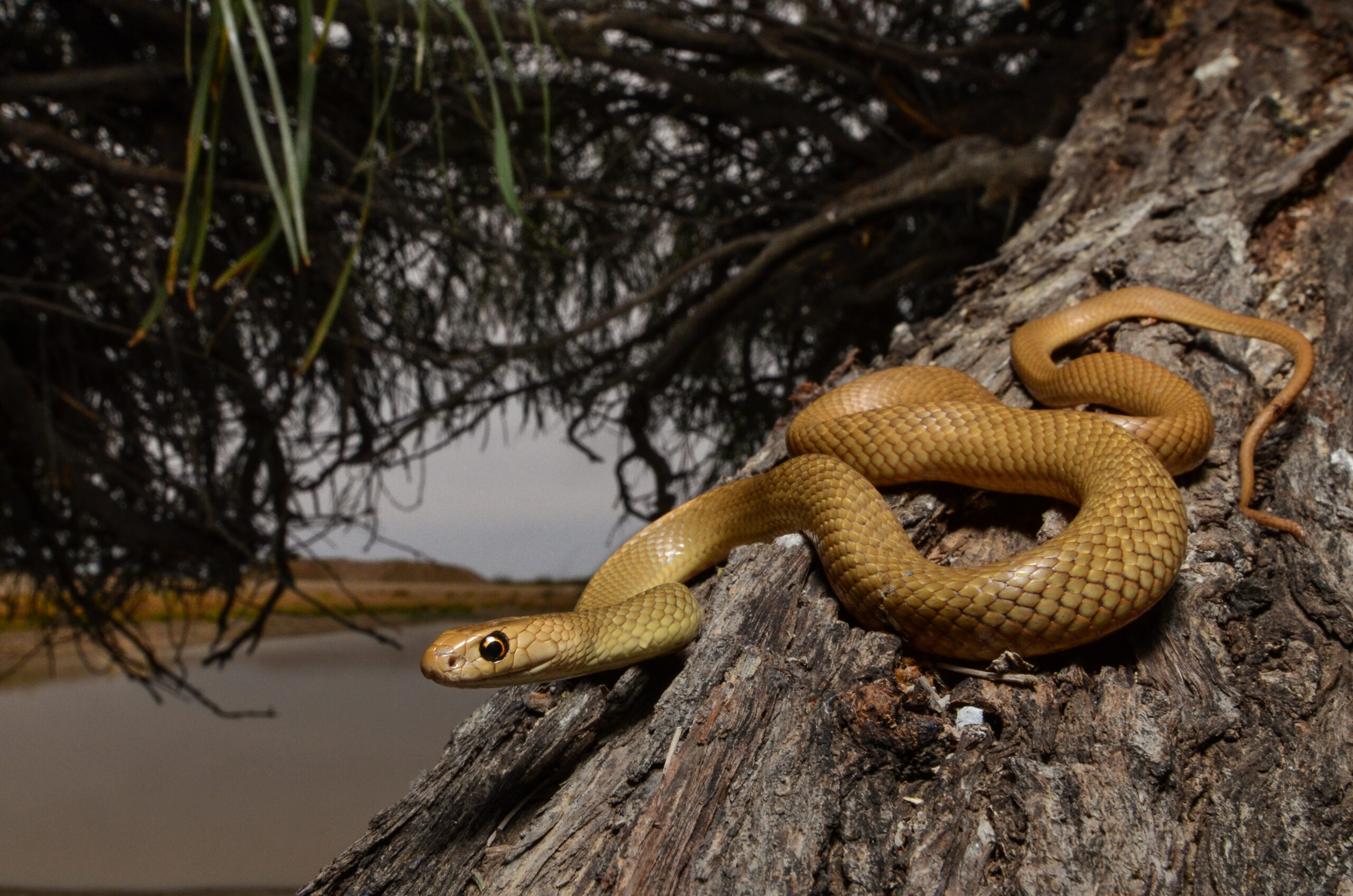
In the open grasslands and dry woodlands of eastern Australia, a sleek and swift silhouette cuts through the heat shimmer – alert, unassuming and entirely at home in the sun-drenched landscape. The Eastern Brown Snake is one of Australia’s most recognisable reptiles, often feared but rarely understood. Its reputation precedes it – known for potent venom and bold behaviour – yet beneath this notoriety lies a highly adaptable predator, shaped by open country, ecological necessity and an uneasy coexistence with people.
Identification
The Eastern Brown Snake is a slender, long-bodied elapid that can exceed two metres in length, though most adults range between 1.5 and 1.8 metres. Colouration varies widely depending on age, region and individual, ranging from pale tan to dark brown or grey, sometimes with a slight copper or olive tint. Juveniles are often banded or blotched and may display a dark head and collar, which fades as they mature. The belly is typically cream to yellowish with orange or brown flecks. The head is narrow and slightly distinct from the neck and the eyes are large with round pupils – a feature that supports its excellent daytime vision and alert disposition.
Habitat and Distribution
The Eastern Brown Snake has one of the widest distributions of any Australian snake, occurring across most of eastern Australia, from Cape York Peninsula in Queensland through New South Wales and Victoria and into South Australia and parts of central Australia. It thrives in a range of habitats including dry sclerophyll forest, grassland, scrubland, agricultural land and even urban edges. In Queensland, it is common in inland and coastal lowlands, often found near farms, paddocks and semi-cleared bushland where shelter and prey are abundant. It seeks refuge under debris, logs, or in burrows and can be active throughout the day, especially in warmer months.
Ecological Role
As a fast and efficient predator, the Eastern Brown Snake plays a crucial role in regulating populations of small mammals, particularly introduced rodents. It also consumes reptiles, frogs and birds and has adapted well to preying on species associated with agricultural and peri-urban environments. Its ability to exploit disturbed habitats has made it more visible in areas with human activity, where its presence is often misinterpreted as encroachment. In reality, the snake has followed the prey. In turn, it is preyed upon by birds of prey, large monitor lizards and occasionally larger snakes. Its ecological value as a pest controller cannot be overstated – without it, rodent populations could increase unchecked in many regions.
Behaviour and Reproduction
Despite its reputation, the Eastern Brown Snake is generally shy and will retreat if given the opportunity. It relies on its speed to avoid conflict, but when cornered or surprised, it can raise the front of its body, form an S-shape and display an open-mouth threat posture. It may strike rapidly and repeatedly if provoked. Its venom is highly toxic and acts quickly, affecting blood coagulation and the nervous system. Although responsible for the majority of serious snakebite incidents in Australia, bites are rare and usually the result of deliberate handling or accidental contact.
Breeding occurs in spring and early summer, with males engaging in ritual combat to establish dominance. Females lay clutches of 10 to 35 eggs in abandoned burrows, compost piles, or other warm, moist sites. Hatchlings emerge after approximately two months and are fully venomous and independent from birth. Like adults, juveniles are alert and active foragers.
Conservation Status
The Eastern Brown Snake is listed as Least Concern under the Queensland Nature Conservation Act 1992. It is widespread, common in suitable habitats and has shown a remarkable ability to coexist with human-altered environments. Its flexible diet, high mobility and capacity to exploit edge habitats have allowed it to thrive even as other reptiles decline due to fragmentation and urbanisation.
Threats
While not currently at risk, the Eastern Brown Snake faces a number of threats, particularly in areas of high human activity. Road mortality is common, especially in rural areas where snakes may bask on warm bitumen or travel across farmland. Habitat loss and fragmentation can isolate populations and reduce access to prey and shelter. Persecution by humans remains a significant issue, driven by fear and misunderstanding. In some areas, pesticide use and secondary poisoning from rodent baits may also pose risks. Although tolerant of some disturbance, the snake’s long-term survival still depends on habitat connectivity and public tolerance.
Conservation Efforts
The species is protected under state legislation and benefits from general reptile conservation measures. Education campaigns that promote snake awareness, safe coexistence and habitat protection are vital to reducing conflict. Snake catchers and wildlife carers play an important role in relocating snakes safely and fostering positive interactions. Conservation of grassy woodland and dry forest habitat – particularly where it borders farmland – helps maintain robust populations and reduces the likelihood of conflict.
Final Thoughts
The Eastern Brown Snake is a creature of speed, precision and ecological value. Its role as a top predator in open country has made it both feared and respected. While its venomous nature demands caution, it is not the villain it is so often made out to be. It is a reptile driven by instinct, honed by evolution and deeply tied to the rhythms of grassland life. To protect this species is to understand the balance it brings – a balance of predator and prey, of fear and fascination, of wilderness and adaptation. In the sunlit edge of the paddock or the shade of a eucalypt, the brown snake reminds us that nature’s most important players are not always the easiest to live with – but they are among the most vital to keep.
Fauna Resources specialises in the safe handling of a range of different fauna species, through safe, effective and ethical fauna solutions. By providing dedicated fauna services, through passionate fauna specialists, we can support the unique terrestrial ecosystems and rich biodiversity Australia has to offer.
For more information about our specialist fauna services contact Fauna Resources today.