

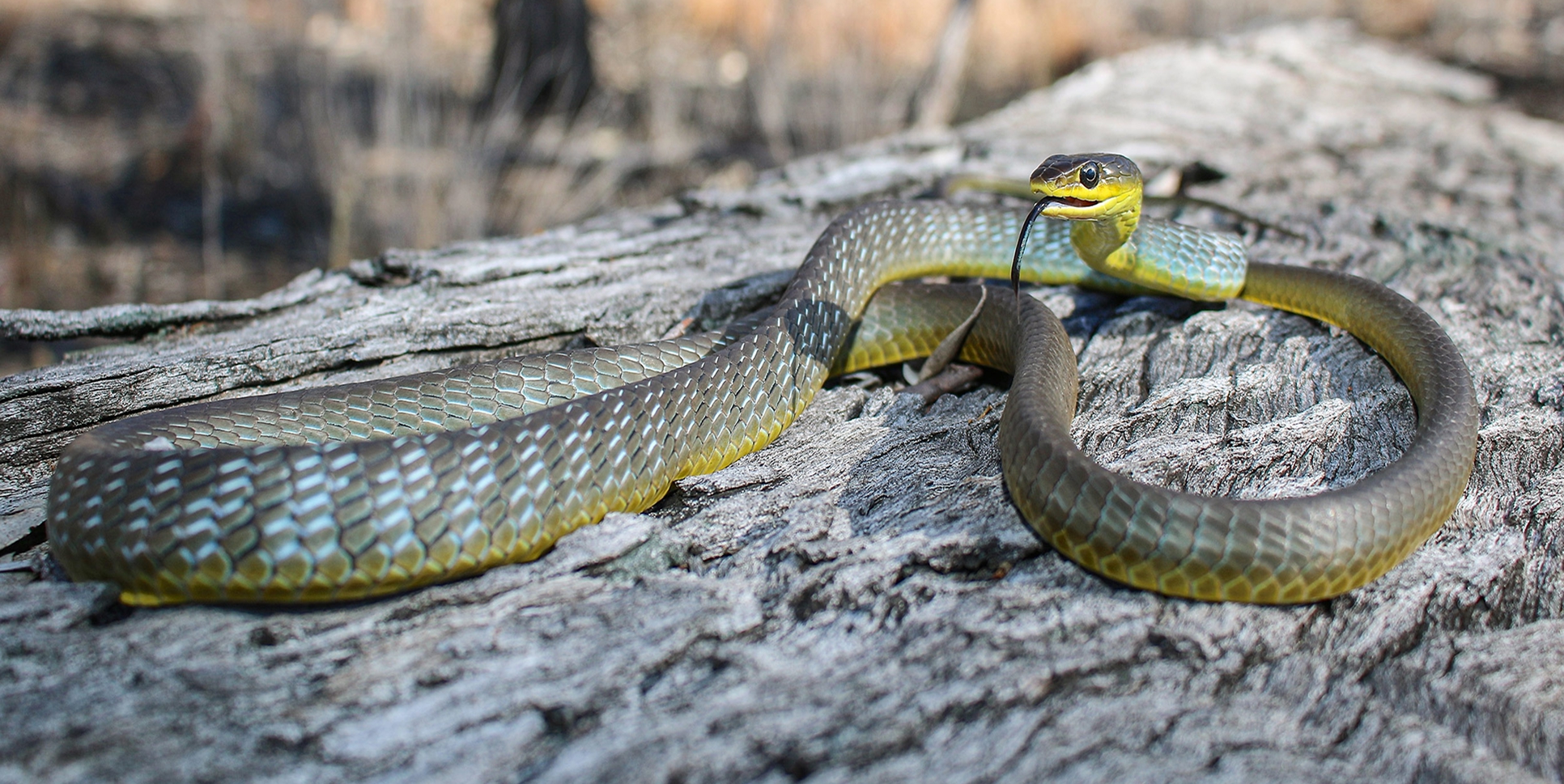
In the treetops of eastern and northern Australia, where sunlight filters through eucalyptus leaves and the air hums with insects, the Green Tree Snake (Dendrelaphis punctulatus) winds gracefully through branches. Non-venomous, agile and quick, this slender reptile is a striking part of Australia’s forests, wetlands and even suburban gardens. Often misidentified as a dangerous species due to its size and speed, the Green Tree Snake is in fact a harmless predator whose presence adds life and balance to its environment.
Identification
The Green Tree Snake is a long and slender species, with adults typically reaching 1.5 to 2 metres in length, though some may exceed 2.5 metres. Colouration is highly variable: while most are bright green, individuals may also appear blue, olive, brown, or even black depending on habitat and region. The ventral surface is usually pale yellow or cream and the throat and chin are often bright yellow. The head is long and narrow, with large, expressive eyes and round pupils. Unlike venomous snakes, D. punctulatus has a fine, whip-like body and lacks a defined brow ridge. Its speed and alertness often give it away when disturbed.
Habitat and Distribution
Dendrelaphis punctulatus is widely distributed across northern and eastern Australia, from Cape York in Queensland through eastern New South Wales and into parts of the Northern Territory and northern Western Australia. It inhabits a range of environments including rainforests, woodlands, open forests, wetlands and urban areas with abundant vegetation. The species is strongly associated with trees and shrubs, though it also hunts on the ground and is a strong swimmer. It is often found near watercourses, lagoons and suburban gardens where frogs and lizards are abundant.
Ecological Role
As a diurnal predator, the Green Tree Snake plays a vital role in controlling populations of frogs, skinks, geckos and small mammals. It also consumes birds and their eggs and occasionally insects. In turn, it provides prey for raptors, larger snakes and predatory mammals. Its adaptability and tolerance of human-modified environments make it an important contributor to biodiversity in both wild and urban ecosystems. Despite its non-venomous nature, it is often mistakenly killed due to fear or misidentification.
Behaviour and Reproduction
Green Tree Snakes are highly active during the day, moving swiftly through foliage or across the ground in search of prey. When disturbed, they may inflate their neck to appear larger, exposing bright blue skin between the scales – a bluff display that deters predators. If handled, they may release a strong-smelling musk. They are non-venomous and not aggressive, preferring to flee rather than confront.
Breeding occurs in spring and summer. Females lay clutches of 5 to 16 elongated eggs in sheltered sites such as hollow logs, tree hollows, or beneath leaf litter. Hatchlings emerge in late summer to early autumn, already skilled hunters capable of capturing small skinks and frogs.
Conservation Status
The Green Tree Snake is listed as a species of Least Concern across its range. It is abundant in many habitats and adapts readily to urban and agricultural landscapes.
Threats
Although widespread and secure, the species faces threats from habitat loss due to land clearing, wetland drainage and urban development. Road mortality is common, as individuals are active and often cross open ground. Predation by domestic cats and dogs further impacts suburban populations. Misidentification and deliberate killing remain significant human-related threats.
Conservation Efforts
The species benefits from the protection of forests, wetlands and riparian corridors. Community education about snake identification and the harmless nature of D. punctulatus is key to reducing unnecessary persecution. Wildlife rescue and relocation programs frequently assist Green Tree Snakes found in suburban settings, helping to promote coexistence.
Final Thoughts
The Green Tree Snake is a symbol of grace and adaptability – a reptile that thrives in forests, wetlands and even backyards. Far from a threat, it is an ally in keeping ecosystems healthy, controlling frogs and reptiles while maintaining the delicate balance of its environment. To protect Dendrelaphis punctulatus is to protect the quiet beauty of Australia’s tree canopies and the hidden worlds within our gardens.
Fauna Resources specialises in the safe handling of a range of different fauna species, through safe, effective and ethical fauna solutions. By providing dedicated fauna services, through passionate fauna spotter catchers and fauna specialists, we can support the unique terrestrial ecosystems and rich biodiversity Australia has to offer.
For more information about our specialist fauna services contact Fauna Resources today.