

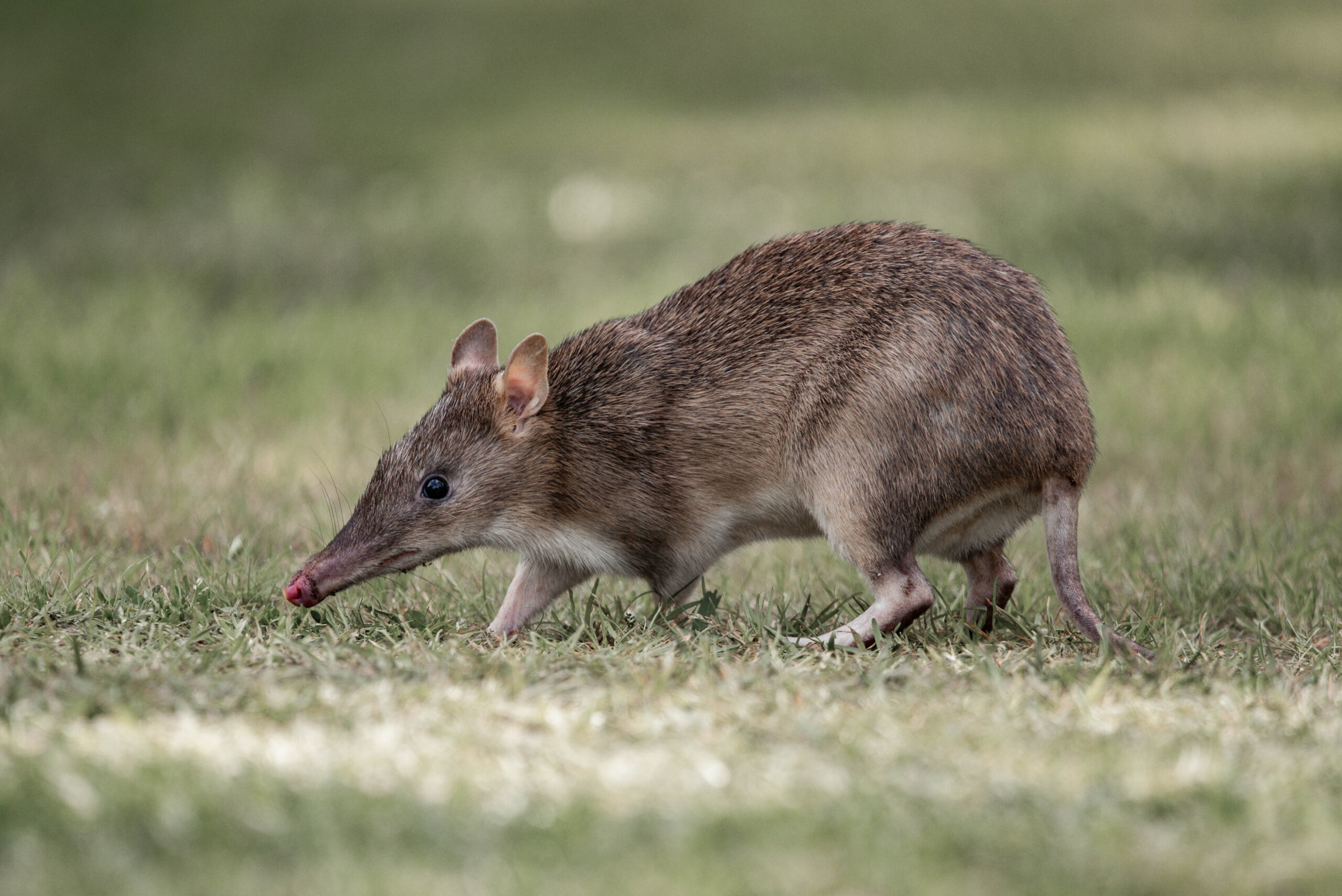

Emerging after dusk with a twitching nose and a shuffling gait, the Long-nosed Bandicoot (Perameles nasuta) is a familiar, if elusive, resident of eastern Australia’s forests and suburban fringes. With its pointed snout, hunched posture and inquisitive digging habits, this small marsupial carries out much of its life under the cover of night. Once widespread, it remains a resilient generalist, though urban expansion and predation pressures continue to chip away at its strongholds.
Identification
The Long-nosed Bandicoot is a compact, terrestrial marsupial, typically measuring 30-43 cm in body length with a tail adding another 12-17 cm. Adults weigh between 0.7 and 1.5 kg. Its most distinguishing feature is the elongated, tapered snout used for foraging. The fur is coarse and greyish-brown dorsally, with a paler underbelly and a naked, rat-like tail. It has strong forelimbs and clawed digits adapted for digging and its hunched appearance is accentuated by short forelegs and longer hindlimbs.
Habitat and Distribution
Perameles nasuta is distributed along the eastern seaboard of Australia, from far north Queensland through New South Wales to eastern Victoria. It inhabits a range of environments including wet and dry sclerophyll forests, rainforest margins and dense understorey thickets. In urban areas, it is occasionally found in parks, gardens and remnant vegetation patches, especially where ground cover remains intact. Shelters are often constructed as nests made of grass and leaves within burrows or under debris.
Ecological Role
As an ecosystem engineer, the Long-nosed Bandicoot plays a significant role in soil turnover and aeration. Its foraging method – digging small conical pits known as ‘snout pokes’ – helps to mix leaf litter and promote nutrient cycling. It feeds on a variety of invertebrates including insects, larvae, worms and spiders, supplemented with fungi, roots and tubers. By dispersing fungal spores and disturbing soil layers, it contributes to forest regeneration and understorey dynamics.
Behaviour and Reproduction
This species is solitary and nocturnal, emerging at night to forage and retreating to shelter by dawn. It is territorial, with overlapping home ranges maintained by scent marking. Long-nosed Bandicoots are polyoestrous and can breed throughout the year, with peaks during spring and summer.
Gestation lasts just 12 days – one of the shortest of any mammal – and females give birth to 2–4 young, which remain in the backward-opening pouch for up to 50 days. After leaving the pouch, juveniles stay in the nest for another week before becoming independent. Females may have up to four litters a year under ideal conditions, allowing for rapid population recovery when threats are minimal.
Conservation Status
In Queensland, the Long-nosed Bandicoot is listed as Least Concern under the Nature Conservation Act 1992. In Western Australia, this species is not naturally present and is not listed under the Biodiversity Conservation Act 2016. Nationally, it is considered secure across most of its range, although local declines are evident in some urban areas, particularly in Sydney where populations have been significantly reduced or fragmented.
Threats
Major threats to Perameles nasuta include predation by introduced species such as foxes, cats and dogs, as well as habitat loss and fragmentation due to urban development. Road mortality is also common in peri-urban areas where bandicoots attempt to cross roads at night. In some regions, habitat degradation from invasive weeds and altered fire regimes reduces ground cover essential for nesting and foraging. Additionally, increased human-wildlife conflict occurs when the species forages in gardens or lawns, leading to negative public perceptions.
Conservation Efforts
Urban wildlife corridors, roadside underpasses and predator control programs all play a role in supporting remaining populations, especially in peri-urban regions. Education campaigns help build community support for co-existence, particularly in areas where bandicoots persist in suburban habitats. The protection of remnant vegetation patches and the restoration of understorey vegetation improve habitat quality and connectivity. Monitoring programs in urban and peri-urban locations, particularly in Greater Sydney and southeast Queensland, assist in tracking population changes.
Final Thoughts
The Long-nosed Bandicoot is a tenacious digger and a quiet survivor of Australia’s changing landscapes. Whether shuffling through leaf litter in remnant bushland or scuttling beneath garden hedges, its presence reflects the resilience of native fauna in the face of urbanisation. Protecting Perameles nasuta means maintaining the integrity of both natural and urban ecosystems and recognising that even the smallest nocturnal forager contributes to the balance of our shared spaces.
Fauna Resources specialises in the safe handling of a range of different fauna species, through safe, effective and ethical fauna solutions. By providing dedicated fauna services, through passionate fauna spotter catchers and fauna specialists, we can support the unique terrestrial ecosystems and rich biodiversity Australia has to offer.
For more information about our specialist fauna services contact Fauna Resources today.