

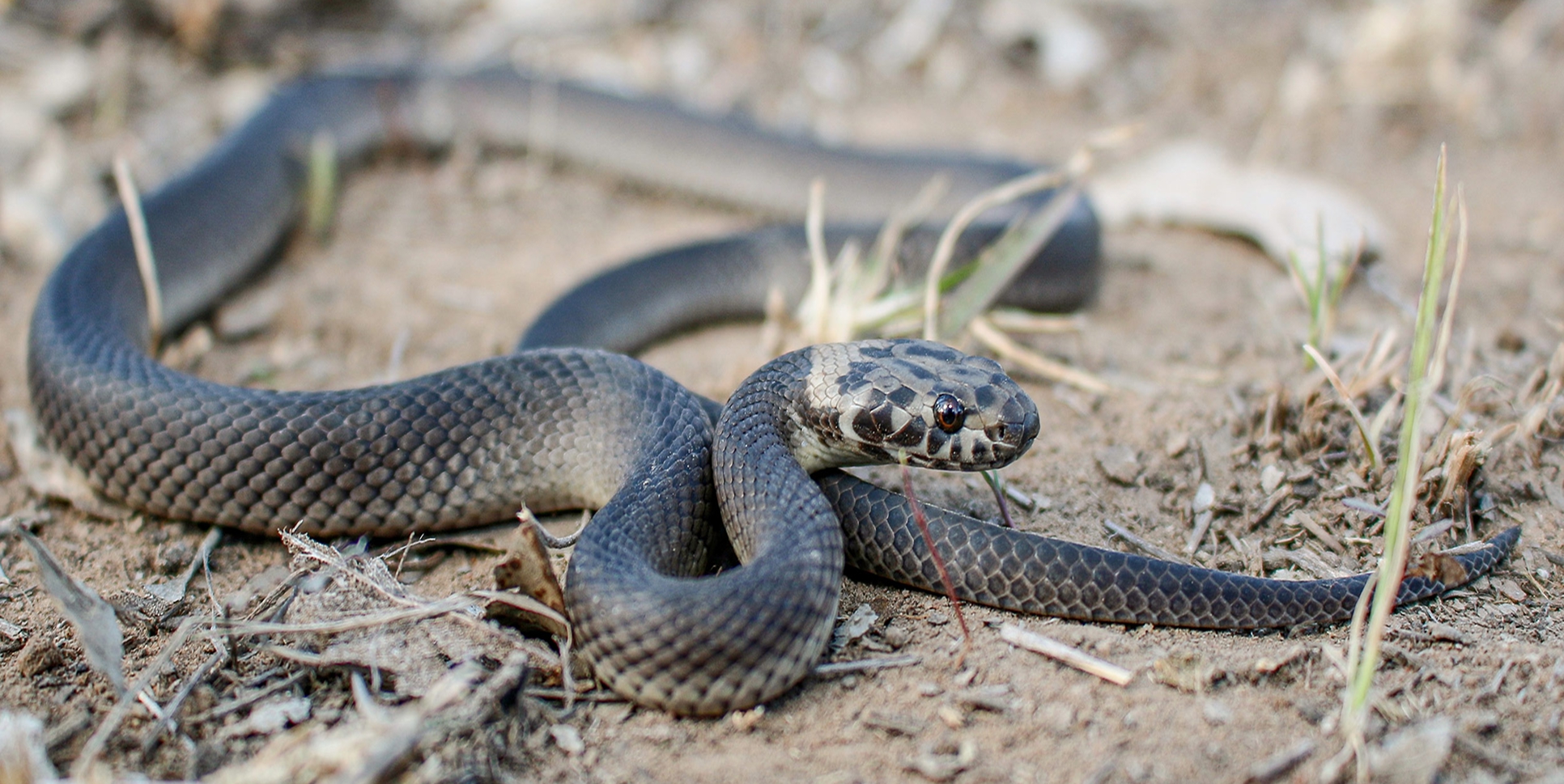
In the dense eucalypt forests and vine thickets of eastern Australia, a slender, secretive snake winds its way through tree hollows and beneath loose bark, cloaked in shadow and silence. The Pale-headed Snake is a little-known but strikingly marked elapid, rarely encountered due to its nocturnal habits and largely arboreal nature. Despite its potent venom and elegant presence, it remains one of Australia’s more mysterious serpents – a symbol of the hidden life that thrives in the treetops and understorey.
Identification
The Pale-headed Snake is a medium-sized elapid, typically reaching between 50 and 90 centimetres in length. Its name comes from the pale cream to silvery-grey colouring of its head and nape, often sharply contrasting with the darker olive-brown to grey tones of its body. A distinctive dark collar may encircle the neck, with a second dark band sometimes present behind the head. The body is slender, with smooth scales and a slightly compressed form suited to climbing. The eyes are large with round pupils and the tail is prehensile, aiding its arboreal movement. Despite its discreet appearance, the snake possesses a strong neurotoxic venom, although bites are exceptionally rare due to its reclusive behaviour.
Habitat and Distribution
This species occurs along the eastern coastal margin of Australia, from the central coast of Queensland south into New South Wales. It inhabits dry sclerophyll forest, open woodland, vine thickets and the edges of rainforest, particularly where hollow-bearing trees and exfoliating bark are present. While often associated with rocky slopes and escarpments, the Pale-headed Snake is semi-arboreal and can frequently be found sheltering in tree hollows, logs or the upper branches of eucalypts. It is most active at night and is rarely seen during daylight hours, even in areas where it is locally established.
Ecological Role
The Pale-headed Snake preys on frogs, skinks, geckos and small mammals, using stealth and agility to capture prey among rocks and vegetation. Its climbing ability allows it to exploit arboreal prey sources, including tree-dwelling reptiles and nesting birds. As both predator and prey, it plays a role in maintaining the balance of vertebrate populations within forest ecosystems. Its reliance on hollow trees and complex understorey structure makes it a valuable indicator species for mature forest health and connectivity.
Behaviour and Reproduction
This species is nocturnal and secretive, spending daylight hours concealed within hollow limbs, bark crevices or rock fissures. At night it may forage on the ground or in low vegetation, often moving with slow, deliberate motion. It is generally non-aggressive, relying on camouflage and retreat rather than confrontation. When threatened, it may rear its head and flatten its neck, though it rarely strikes unless provoked.
The Pale-headed Snake is viviparous, giving birth to live young rather than laying eggs. Females typically produce litters of four to eight offspring, usually in late summer. Newborn snakes are independent from birth and capable of fending for themselves immediately. Details of courtship and reproductive behaviour remain poorly known due to the species’ cryptic nature.
Conservation Status
In Queensland, the Pale-headed Snake is listed as Least Concern under the Nature Conservation Act 1992. This status is positive despite its reliance on specific habitat features and its sensitivity to habitat fragmentation and degradation. While it is not considered globally threatened, its occurrence is considered sporadic and poorly documented across much of its range.
Threats
The primary threat to the Pale-headed Snake is habitat loss – particularly the clearing of mature eucalypt forest, which reduces the availability of tree hollows and shelter sites. Firewood harvesting, land development and inappropriate fire regimes can further diminish suitable habitat. As a slow-moving and arboreal species, it is also vulnerable to predation by feral cats and birds of prey, particularly when foraging on the ground. Road mortality may impact some populations, especially where roads intersect woodland corridors. Due to its venomous nature, it may also be killed by humans out of fear or misunderstanding.
Conservation Efforts
Conservation of the Pale-headed Snake involves preserving mature woodland and forest habitats with an abundance of hollow trees and fallen logs. Management of fire regimes to prevent the loss of shelter sites is essential. Improved survey techniques and targeted monitoring programs are helping to clarify its distribution and habitat use. Public education aimed at reducing fear and encouraging the protection of tree-dwelling reptiles supports broader conservation objectives for this and other forest-dependent species.
Final Thoughts
The Pale-headed Snake is a quiet inhabitant of the forest – rarely seen, often overlooked, yet deeply reliant on the structure and rhythm of its woodland home. To protect this species is to value the slow-growing trees, the hollow limbs and the nocturnal intricacies of eastern Australia’s forests. It is a reminder that not all wildness moves in the open and that some of the most extraordinary lives are lived quietly, by moonlight, along the rough bark of an ancient eucalypt.
Fauna Resources specialises in the safe handling of a range of different fauna species, through safe, effective and ethical fauna solutions. By providing dedicated fauna services, through passionate fauna spotter catchers and fauna specialists, we can support the unique terrestrial ecosystems and rich biodiversity Australia has to offer.
For more information about our specialist fauna services contact Fauna Resources today.