

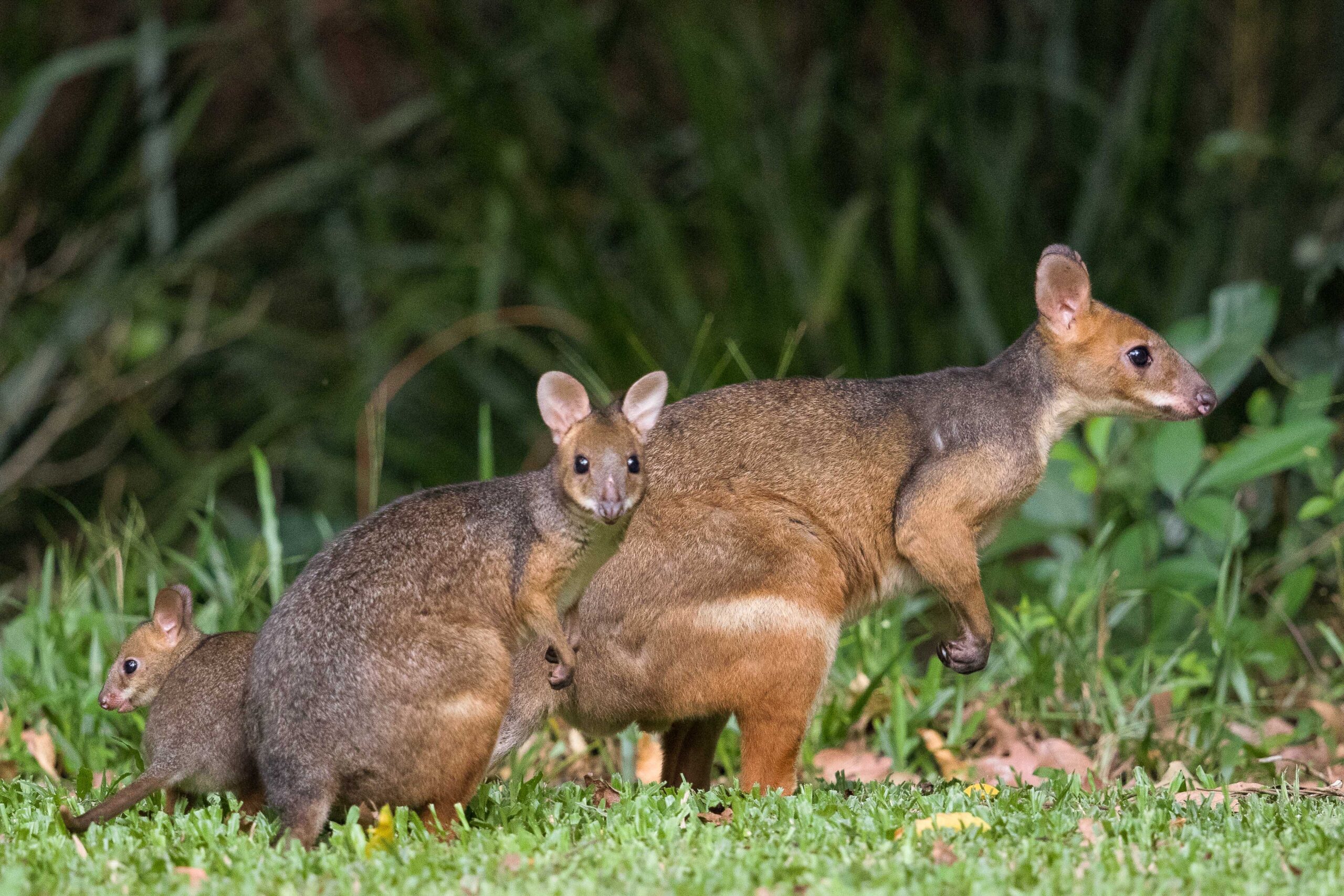
Hidden in the dense undergrowth of tropical and subtropical forests, the Red-legged Pademelon (Thylogale stigmatica) is a shy, ground-dwelling macropod that often goes unnoticed by human eyes. Its name comes from the distinctive rusty-red colouration on its forelimbs and hindlegs, which glow in contrast to its darker body. Endemic to northeastern Australia and parts of New Guinea, the Red-legged Pademelon is a quiet but vital presence in the rainforest, a reminder of the delicate life that thrives in the shade of the canopy.
Identification
The Red-legged Pademelon is a small wallaby, with a head-body length of 60-70 cm and a tail of 30-50 cm. Adults weigh between 4-12 kg, with males larger than females. Its fur is generally grey-brown above, fading to lighter tones on the underparts, with distinctive reddish fur on the limbs, flanks and base of the tail. The face is short and rounded, with dark eyes and small, rounded ears. Unlike larger kangaroos and wallabies, its compact build is perfectly suited to navigating dense forest floor vegetation.
Habitat and Distribution
Thylogale stigmatica is found in far north and eastern Queensland, extending through the Wet Tropics, Cape York Peninsula and southward to around Townsville. It also occurs in southern New Guinea. Its preferred habitats are rainforests, vine thickets and wet sclerophyll forests, where dense understorey provides cover from predators and shelter during the day. It is most often encountered near clearings, tracks, or forest edges where grasses and herbs provide feeding opportunities.
Ecological Role
As a herbivore, the Red-legged Pademelon feeds on a variety of grasses, herbs, leaves and fallen fruit. In rainforests, it plays a key role in seed dispersal, aiding the regeneration of native plant species. Its browsing also influences understorey vegetation structure. In turn, it serves as prey for dingoes, pythons and large raptors. This balance between feeding and being fed upon makes it an important link in forest ecosystems.
Behaviour and Reproduction
Red-legged Pademelons are solitary or live in loose groups, often emerging from dense cover to forage at dawn or dusk. By day, they rest in well-concealed thickets. When disturbed, they retreat quickly into dense vegetation, often with a characteristic thumping of the hind feet as a warning signal.
Breeding occurs year-round in tropical regions. Females usually give birth to a single joey, which remains in the pouch for around 6 months and is weaned at about 8-9 months. Like other macropods, females are capable of embryonic diapause, delaying the development of a second embryo until conditions are favourable.
Conservation Status
In Queensland, the Red-legged Pademelon is listed as a species of Least Concern under the Nature Conservation Act 1992, reflecting its relatively wide distribution and secure populations within the state’s rainforests.
Threats
Despite being secure overall, local populations face pressures from habitat loss and fragmentation, particularly the clearing of lowland rainforest for agriculture and development. Predation by feral cats and dogs remains a significant threat, especially to young animals. Road mortality also affects populations near human settlements. Climate change, through altered rainfall and cyclone activity, poses long-term risks to rainforest ecosystems critical for this species’ survival.
Conservation Efforts
The species benefits from the extensive network of protected areas across Queensland’s Wet Tropics World Heritage Area and other rainforest reserves. Habitat protection and predator control programs are critical for long-term security. Education campaigns in local communities encourage coexistence and highlight the importance of understorey vegetation for pademelons and other small macropods. Continued monitoring of populations ensures early detection of declines and informs management strategies.
Final Thoughts
The Red-legged Pademelon is a shy custodian of the rainforest floor – a quiet browser whose presence ensures seeds are spread and understorey plants thrive. Though easily overlooked, its ecological role is profound. Protecting Thylogale stigmatica is ultimately about safeguarding the integrity of Queensland’s rainforests, ensuring that the dappled shade remains alive with the movement of these elusive, red-legged marsupials.
Fauna Resources specialises in the safe handling of a range of different fauna species, through safe, effective and ethical fauna solutions. By providing dedicated fauna services, through passionate fauna spotter catchers and fauna specialists, we can support the unique terrestrial ecosystems and rich biodiversity Australia has to offer.
For more information about our specialist fauna services contact Fauna Resources today.