

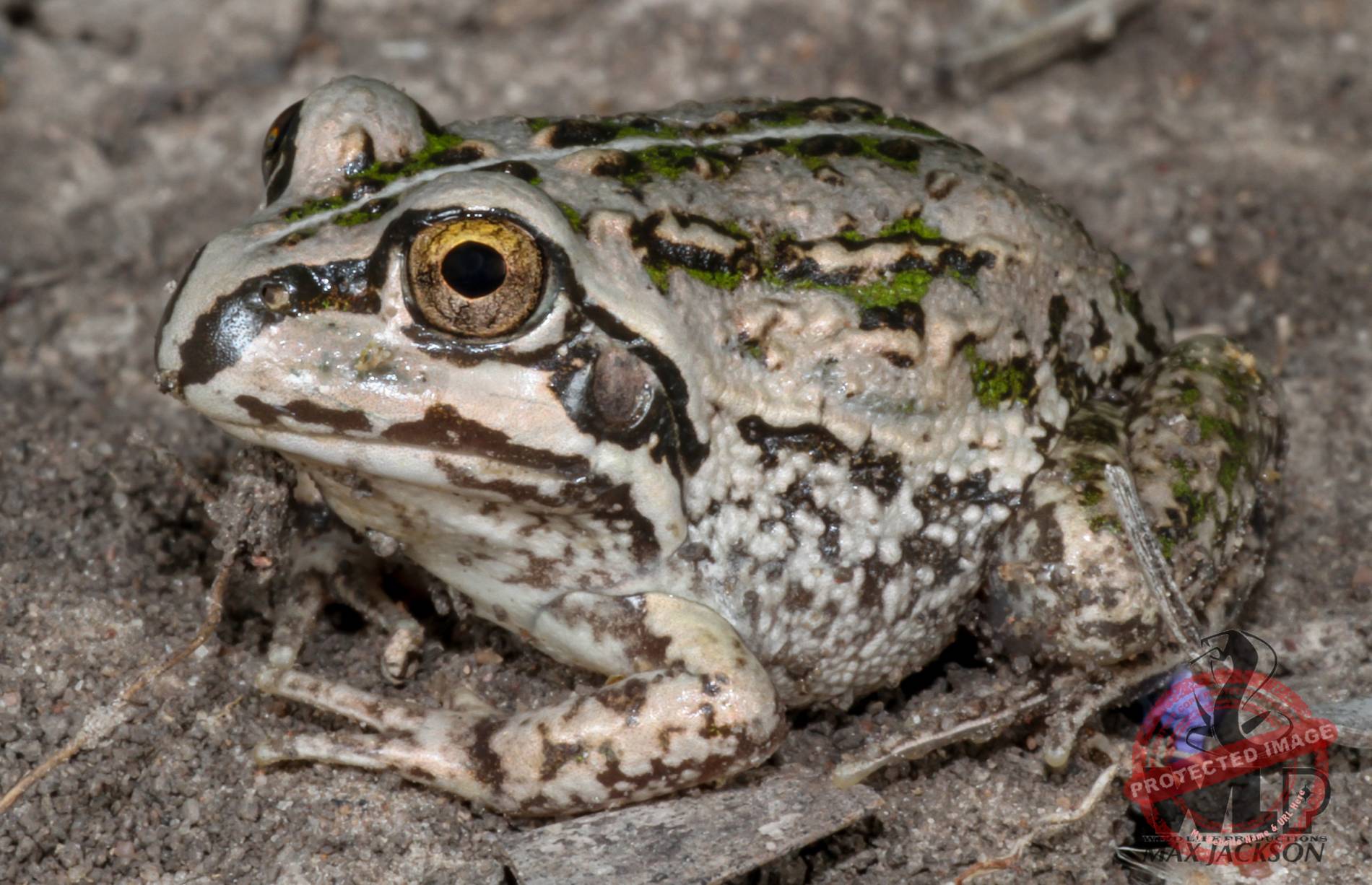
In the arid and semi-arid landscapes of inland southeastern Queensland and northern New South Wales, where clay soils crack under the relentless sun and ephemeral waterholes dot the terrain, a resilient amphibian bides its time beneath the surface. The Rough Collared Frog, also known as the Rough Frog, is a burrowing species uniquely adapted to survive in these challenging environments. Emerging only after substantial rainfall, it epitomises nature’s ingenuity in the face of climatic extremes.
Identification
The Rough Collared Frog is a medium-sized amphibian, with females typically reaching body lengths of 37 to 49 millimetres, while males measure slightly smaller at 35 to 45 millimetres. Its robust body is adorned with rough, warty skin – a distinguishing feature that sets it apart from other frogs within its range. Colouration varies, often presenting as grey-brown to olive-brown, interspersed with irregular dark green or black patches. A characteristic thin, pale cream stripe runs longitudinally along the centre of its back, providing a subtle contrast to its mottled appearance. The underbelly is generally whitish and males possess a greyish throat. A notable dark band extends from the snout, passing through the eye and continues along the body’s side, further enhancing its cryptic camouflage.
Habitat and Distribution
Endemic to Australia, the Rough Collared Frog’s distribution spans inland regions of southeastern Queensland and northern New South Wales, excluding coastal and highland areas. It thrives in open grasslands and woodlands characterised by clay soils, often in proximity to seasonal ponds, creeks and claypans. These habitats are subject to periodic flooding, creating the temporary aquatic environments essential for the frog’s breeding and feeding activities. During extended dry spells, the species employs its burrowing prowess to aestivate underground, conserving moisture and energy until favourable conditions return.
Ecological Role
As an insectivorous amphibian, the Rough Collared Frog plays a pivotal role in regulating insect populations within its ecosystem. By emerging en masse following heavy rains, it partakes in feeding and breeding frenzies that capitalise on the transient abundance of resources. Its burrowing behaviour also contributes to soil aeration and nutrient mixing, subtly influencing the health and dynamics of its habitat.
Behaviour and Reproduction
The life cycle of the Rough Collared Frog is intricately tied to rainfall patterns. Breeding typically occurs from spring to summer and occasionally in autumn, triggered by substantial rainfall events that create suitable ephemeral water bodies. Males produce a distinctive long, moaning growl to attract females. While specific details of their reproductive habits remain elusive, it is believed that females lay eggs beneath the water’s surface in temporary ponds and swamps, similar to related species. The resulting tadpoles are free-swimming and can reach lengths up to 75 millimetres, displaying dull gold or gold-white hues. The duration of their development into terrestrial frogs is not well-documented but is presumed to be rapid to ensure metamorphosis before the ephemeral waters evaporate.
Conservation Status
The Rough Collared Frog is currently classified as Least Concern by the International Union for Conservation of Nature (IUCN), indicating a stable population across its range. However, ongoing monitoring is essential to detect any future declines or emerging threats.
Threats
Despite its current stability, the Rough Collared Frog faces several potential threats. Habitat degradation due to agricultural expansion, particularly the cultivation of non-timber crops, poses a significant risk by altering or destroying essential breeding and foraging grounds. Urbanisation and associated infrastructure development can lead to habitat fragmentation, impeding movement and genetic exchange between populations. Additionally, inappropriate catchment management practices may degrade water quality, further impacting the species’ delicate aquatic habitats. Climate change also looms as a potential threat, with altered rainfall patterns potentially disrupting the frog’s breeding cycles and reducing the availability of suitable ephemeral water bodies.
Conservation Efforts
The species benefits from occurring within several protected areas, offering some refuge from habitat destruction. Conservation efforts should focus on preserving and restoring natural habitats, implementing sustainable agricultural practices and ensuring effective catchment management to maintain water quality. Public education initiatives can also raise awareness about the species and its ecological importance, fostering community support for conservation measures.
Final Thoughts
The Rough Collared Frog exemplifies resilience and adaptability, embodying the spirit of Australia’s arid interior. Its ability to endure prolonged droughts through aestivation and seize fleeting opportunities for reproduction following rain showcases a remarkable life strategy honed by evolution. Protecting this species necessitates a commitment to preserving the ephemeral wetlands and clay soil habitats that define its existence, ensuring that the chorus of the Rough Collared Frog continues to resonate across the Australian landscape.
Fauna Resources specialises in the safe handling of a range of different fauna species, through safe, effective and ethical fauna solutions. By providing dedicated fauna services, through passionate fauna spotter catchers and fauna specialists, we can support the unique terrestrial ecosystems and rich biodiversity Australia has to offer.
For more information about our specialist fauna services contact Fauna Resources today.