

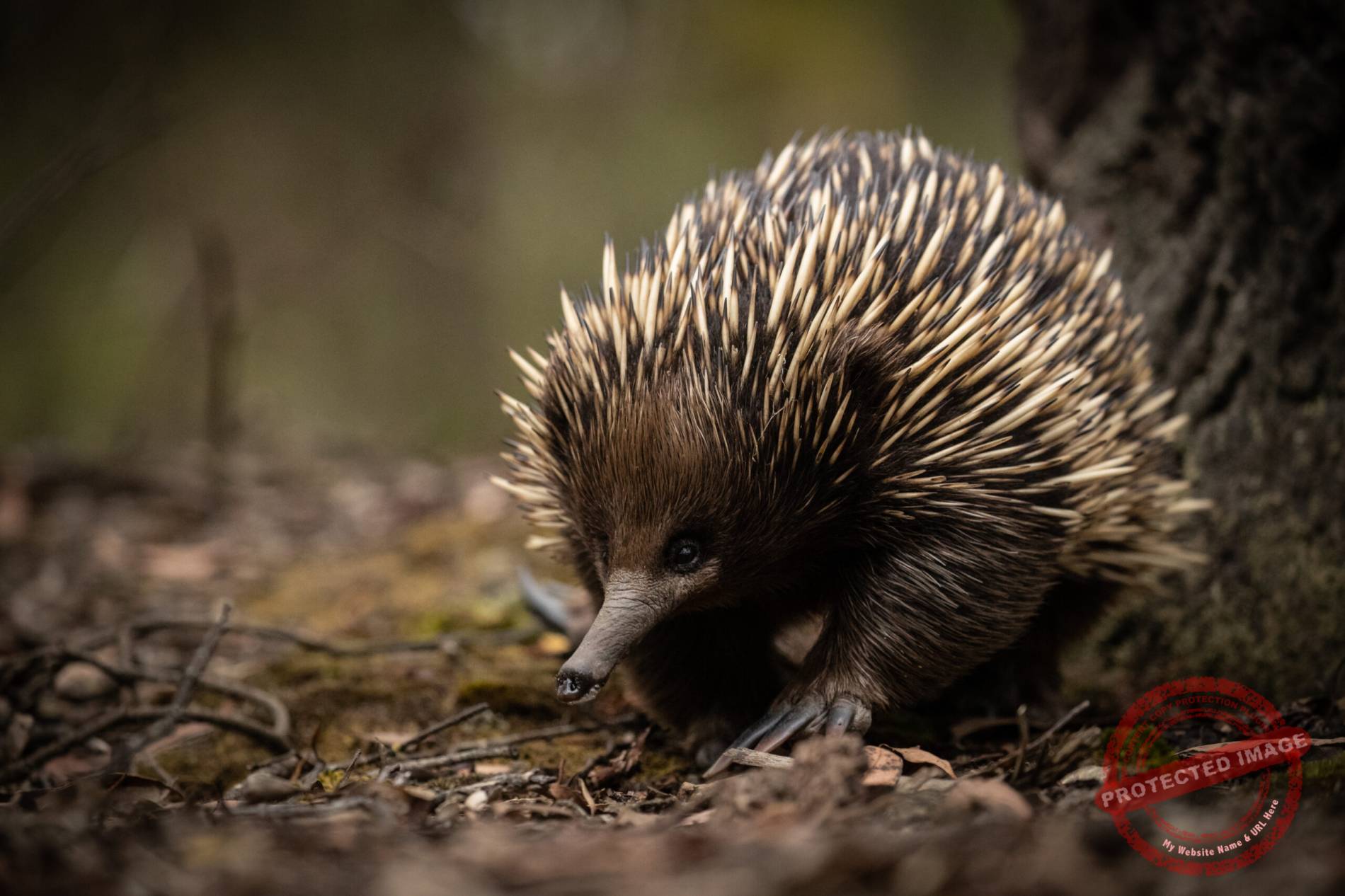
Waddling across sunlit clearings, nosing through forest litter, or curled motionless beneath a log, the Short-beaked Echidna is one of Australia’s most recognisable and enigmatic mammals. With its coat of coarse hair and sharp spines, tubular snout and long, sticky tongue, it seems a creature of contradiction – ancient yet enduring, secretive yet widespread. As a monotreme, the echidna lays eggs but nurses its young with milk, a reminder of a lineage that predates all placental mammals. It is a living fossil, a survivor of deep time and a quiet sentinel of the bush.
Identification
The Short-beaked Echidna is a medium-sized mammal, typically weighing between 2 and 7 kilograms, with a body length ranging from 30 to 45 centimetres. Its back is covered in a dense mix of fur and sharp, cream-coloured spines used for defence. The limbs are short and powerfully muscled, ending in large, curved claws adapted for digging. The snout is long and slender, housing electroreceptors that help locate underground prey. The tongue is extremely long – up to 18 centimetres – and coated in sticky mucus, used to catch ants and termites. Lacking teeth, the echidna crushes its food with keratinous pads at the back of the mouth. Males have a spur on the hind leg, but unlike the platypus, it is not venomous.
Habitat and Distribution
The Short-beaked Echidna is found across nearly all of mainland Australia and Tasmania, occupying an extraordinary range of habitats from desert scrub and alpine forest to coastal heath and tropical woodland. It is adaptable and resilient, surviving in both remote wilderness and peri-urban environments. The species requires access to loose or friable soil for digging and shelter and its presence is often indicated by the small, conical holes it leaves behind while foraging for insects. During hot or cold extremes, it shelters in burrows, hollow logs or dense vegetation.
Ecological Role
As an insectivore, the echidna plays a critical role in regulating populations of ants, termites and other soil invertebrates. Its foraging activity disturbs the soil, improving aeration, mixing organic matter and promoting seedling germination – functions that support healthy ecosystem processes. It serves as prey for dingoes, large birds of prey and feral predators, though its defensive spines and burrowing behaviour provide effective protection. The echidna’s low metabolic rate and solitary lifestyle reflect a strategy of energy conservation well suited to Australia’s variable climate.
Behaviour and Reproduction
Echidnas are largely solitary and nomadic, travelling significant distances in search of food or mates. They are most active during cooler periods of the day, particularly dawn and dusk, though this varies with climate. When threatened, an echidna will dig into the soil or wedge itself between rocks, presenting only a mass of spines to would-be predators.
Breeding occurs in late winter and early spring. Males follow females in a loose procession known as a “train”, often for days before mating. After fertilisation, the female lays a single leathery egg and places it in a pouch-like skin fold on her abdomen. The egg hatches after about 10 days and the tiny, naked young – called a puggle – remains in the pouch for several weeks. Once spines begin to develop, the female deposits the puggle in a burrow and returns periodically to nurse it with milk secreted from specialised mammary patches. Weaning occurs at around 6 to 8 months of age.
Conservation Status
The Short-beaked Echidna is listed as Special Least Concern in Queensland under the Nature Conservation Act 1992. It remains widespread and relatively common, though often under-recorded due to its solitary and cryptic nature. It is considered an important species for ecological monitoring due to its unique and sensitive breeding habits, and cultural heritage, particularly among First Nations communities who have long recognised its place in the landscape.
Threats
Despite its adaptability, the echidna faces several threats. Habitat loss from clearing, development and fire reduces shelter availability and increases exposure to predators. Road mortality is a major cause of death, particularly in peri-urban and rural areas. Feral dogs and foxes may kill young or weakened individuals, while livestock trampling and soil compaction can degrade burrowing habitat. Climate change may impact food availability and alter the seasonal timing of breeding. In some areas, echidnas are vulnerable to injury from barbed wire fences or entanglement in garden netting.
Conservation Efforts
Echidnas benefit from general land management strategies that maintain native vegetation, limit invasive species and reduce roadkill. Public education campaigns have helped raise awareness about their ecological importance and promote safe garden practices such as echidna-friendly fencing and avoidance of slug pellets. Citizen science initiatives, including echidna sighting apps and community wildlife surveys, are improving understanding of distribution, movement and behaviour. Cultural partnerships with Indigenous land managers are supporting place-based conservation and knowledge sharing.
Final Thoughts
The Short-beaked Echidna is an animal of patience, persistence and quiet wonder – unchanged in form for millions of years, yet perfectly attuned to the world as it is today. Its presence is a reminder that some of the most extraordinary lives are lived in slow motion, beneath bark and between roots, in a landscape shaped by adaptation and silence. To protect the echidna is to protect the pulse of the earth itself – the living soil, the invertebrates within and the gentle creatures that tread softly above.
Fauna Resources specialises in the safe handling of a range of different fauna species, through safe, effective and ethical fauna solutions. By providing dedicated fauna services, through passionate fauna spotter catchers and fauna specialists, we can support the unique terrestrial ecosystems and rich biodiversity Australia has to offer.
For more information about our specialist fauna services contact Fauna Resources today.